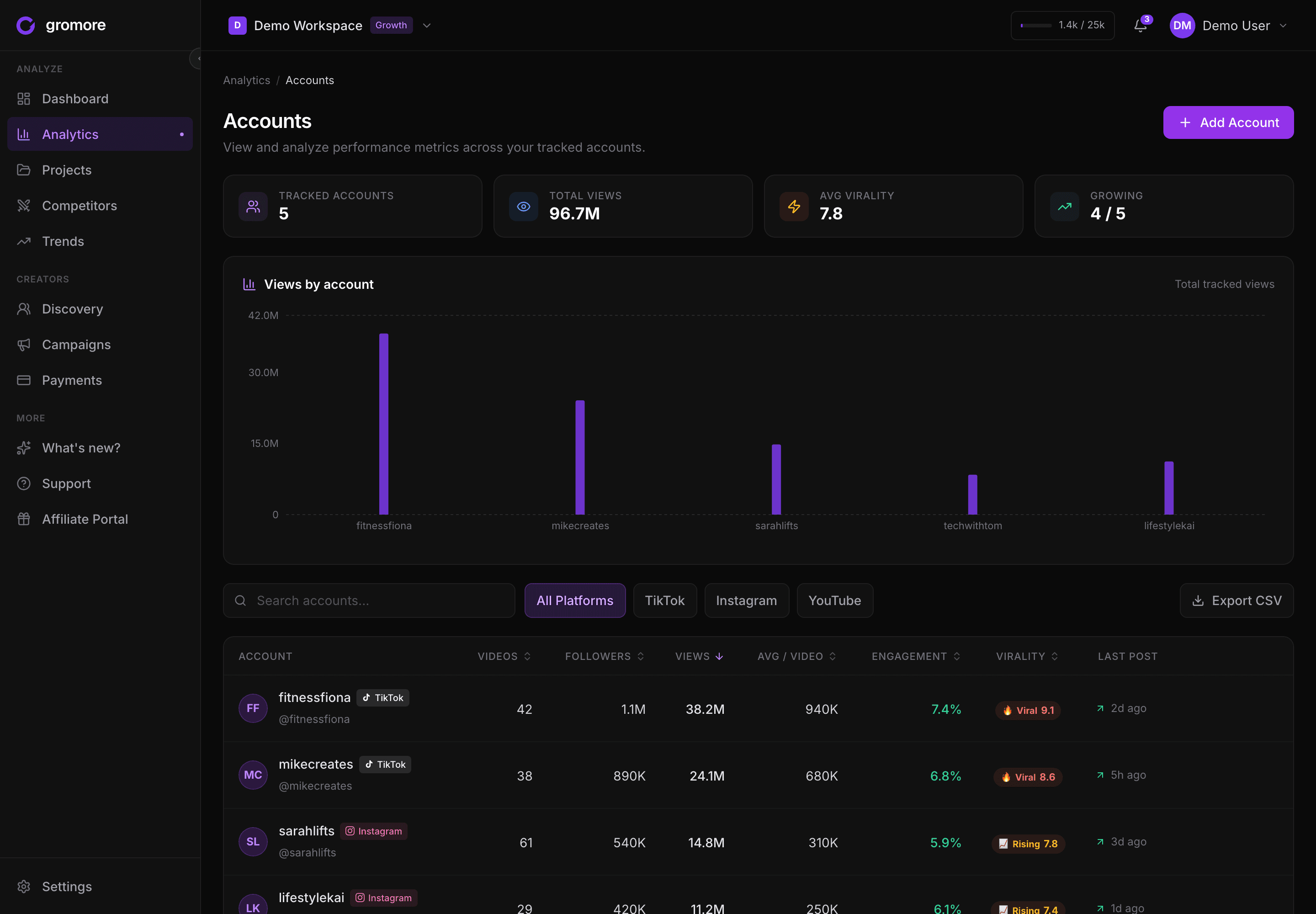
Short answer: CreatorIQ is a powerful enterprise creator platform — with enterprise pricing (commonly reported to start around $36K/year and climb past $150K) and a multi-week onboarding to match. For D2C brands and small-to-mid agencies that need creator analytics, campaigns, and payouts without the enterprise commitment, Gromore covers the same core jobs, self-serve, from $69–$349/mo.
CreatorIQ shows up on most enterprise shortlists for a reason — it's a serious platform. But "enterprise" is exactly why so many D2C brands and smaller agencies go looking for a CreatorIQ alternative: the price, the contract, and the weeks of onboarding are built for a Fortune-500 creator-ops team, not a lean brand that just needs to track creators and pay them on performance.
Here's an honest comparison — what CreatorIQ genuinely does well, where a lighter tool fits better, and who should actually switch.
Why brands look for a CreatorIQ alternative
Three reasons come up repeatedly:
- The price. CreatorIQ doesn't publish pricing, but it's widely reported to start around $36,000/year, with enterprise tiers well past $150,000. For a brand spending five or low-six figures on UGC, the tool shouldn't cost as much as the creators.
- Time to value. A 6–8 week onboarding is commonly cited. That's fine for a large org rolling out governance across teams — but if you need to run a campaign this month, it's a real cost measured in lost momentum.
- It doesn't automate the human parts. CreatorIQ is excellent at managing creators at scale, but outreach, negotiation, and day-to-day coordination still fall on your team. You're buying an enterprise system of record, not a shortcut.
- Data can run on batch schedules. Enterprise platforms often lean on official-API data pulled on a cadence, which can trail what's actually happening on-platform right now. For fast-moving creator content, tracking built for freshness can matter more than governance depth.
If any of those is your situation, a faster, cheaper, self-serve tool usually wins.
What CreatorIQ does well (credit where it's due)
Don't leave a platform that's genuinely serving you. CreatorIQ is strong at:
- Enterprise creator CRM — managing thousands of creator relationships with real structure.
- Compliance, audit, and governance — the controls large regulated brands actually need.
- Large-team operations — roles, approvals, and reporting built for 50–100+ person creator organizations.
If that's your world — heavy governance, a big in-house team, procurement that expects an annual contract — CreatorIQ earns its price. Most growing brands aren't in that world.
Gromore vs CreatorIQ: side by side
| Gromore | CreatorIQ | |
|---|---|---|
| Pricing | $69–$349/mo, published | Not published; reported ~$36K–$150K+/yr |
| Setup time | Same-day, self-serve | Commonly cited 6–8 weeks |
| Free trial | 7-day, no card | Enterprise sales process |
| Platforms | TikTok, Instagram, YouTube | Broad enterprise coverage |
| Payouts | Base + CPM + milestone rules engine + approvals | Enterprise payments module |
| Competitor creator intelligence | Native | Not a core feature |
| Agencies / multiple brands | Multi-workspace (up to 10 clients, one login) | Typically per-instance / enterprise licensing |
| Best for | D2C brands + small-mid agencies | Large enterprise creator orgs |
The pattern: CreatorIQ is a governance-heavy platform priced for scale; Gromore is focused on the analytics → campaigns → payouts loop that most brands actually run, at a price you don't need procurement to approve.
Where Gromore is actually different (not just cheaper)
- Speed to live. Self-serve, same-day setup vs a multi-week onboarding. You can run a real campaign before a CreatorIQ contract would even be signed.
- A real payout rules engine. Set base pay, a CPM ladder, and milestone bonuses as reusable rules; Gromore calculates each creator's payout from tracked performance, with an approval workflow. (It calculates and records — you keep control of the actual transfer.)
- Competitor creator intelligence, built in. See which creators your rivals run — a proven shortlist — natively, not as a separate enterprise add-on.
- Agency-friendly. Running multiple client brands? Multi-workspace under one login beats per-instance enterprise licensing.
If you're also weighing the other big incumbent, see our GRIN alternative breakdown — same searcher, different tool. And for the wider field, the best UGC tracking tools for Shopify brands and the viral.app vs Gromore comparison.
How to evaluate a CreatorIQ alternative
The mistake is comparing on feature count — CreatorIQ will always "win" that contest because it's built for enterprise breadth. Compare on fit instead:
- Total cost of ownership. Not just the license — onboarding, the annual commitment, and the internal time a heavy platform demands. A cheaper tool you actually use beats an expensive one you're still rolling out.
- Time to first campaign. Can you run something real this week? For a growing brand, a multi-week onboarding is momentum you don't get back.
- Does it fit your team size? CreatorIQ's governance shines with a large, multi-role creator org. If you're a handful of people, that governance is overhead, not value.
- Payouts and competitor intel — first-class or bolt-on? If performance payouts and competitor rosters are core to how you work, weight tools that treat them as core features, not enterprise add-ons.
Run any alternative — Gromore included — through those four before you commit.
Who should switch (and who genuinely needs CreatorIQ)
Switch to Gromore if you're: - A D2C brand or small-to-mid agency that wants creator analytics, campaigns, and performance payouts without a five-figure annual contract. - A team that needs to move now, not after a two-month onboarding. - Frustrated that most of CreatorIQ's depth is governance you don't use.
Stay with CreatorIQ if you: - Have Fortune-500-grade compliance, audit, and governance requirements. - Run a 100+ person creator operation that needs enterprise controls. - Are locked into enterprise integrations that are core to your stack.
What to check before you migrate
- Export your data from CreatorIQ — creator list, contacts, and any historical performance you want to keep.
- Hand off active campaigns at a natural boundary (end of a flight) rather than mid-campaign.
- Rebuild your payout rules in Gromore (base + CPM + milestone) so payouts calculate automatically from day one.
- Add 2–3 competitors so competitor creator intelligence starts building your next shortlist immediately.
Quick answers
Is Gromore a true CreatorIQ competitor? For D2C brands and smaller agencies, yes — it covers the core analytics/campaigns/payouts loop. For a Fortune-500 governance program, CreatorIQ is a different (heavier) product.
How much cheaper is it? CreatorIQ is reported to start around $36K/year; Gromore runs $69–$349/mo with a free trial — an order-of-magnitude difference for most brands.
Can I be live quickly? Yes — same-day, self-serve, versus a commonly-cited 6–8 week CreatorIQ onboarding.
Will I lose my data if I leave CreatorIQ? No — export your creator list and historical performance first (step one of the migration checklist above). A platform you can cleanly export from is one you can safely leave.
Is a cheaper tool just a worse tool? Not for most brands. "Cheaper" here means scoped to what you actually use — you're not paying for enterprise governance, compliance tooling, and a large-team rollout you'll never touch. For the analytics → campaigns → payouts loop, focus beats breadth.
Bottom line
CreatorIQ is a strong platform for large, governance-heavy creator organizations. If that's not you, its price and onboarding are overhead you don't need. Gromore gives D2C brands and small-mid agencies the same core loop — analytics, campaigns, and performance payouts, plus competitor intelligence — self-serve, for a fraction of the cost. Start with the UGC analytics guide for the full framework.
See it for yourself — start a free 7-day Gromore trial, no card required, and run your first campaign this week instead of next quarter.