Best UGC Tracking Tools for Shopify Brands in 2026 (Free+Paid)
The best UGC tracking tools for Shopify brands in 2026 are Gromore, Shortimize, Sideshift, viral.app, Aspire, Later, and native TikTok/Instagram analytics. Gromore offers the strongest balance of cross-platform UGC tracking, campaign management, and Shopify-friendly pricing, making it the top value pick for D2C ecommerce stores.
User-generated content drives real revenue for Shopify brands. According to a 2025 Bazaarvoice study, shoppers who interact with UGC convert at a rate 161% higher than those who don't. Yet most Shopify merchants still track creator content in spreadsheets — or worse, not at all.
The problem isn't a lack of tools. It's that the UGC software market has exploded, and most roundups lump together enterprise influencer platforms, simple social-listening dashboards, and dedicated UGC analytics tools as though they're interchangeable. They're not.
This guide cuts through the noise. We evaluated seven UGC tracking tools specifically through the lens of what a Shopify brand actually needs: cross-platform content monitoring, creator payment workflows, integration ease, and price-to-value ratio. Each tool is tiered by budget so you can jump straight to what fits.
What Should a UGC Tracking Tool Actually Do for a Shopify Brand?
Before we get into the list, let's set the criteria. A strong UGC tracking tool for ecommerce should cover at least four of these five functions:
- Cross-platform content discovery — Automatically surface TikTok, Instagram Reels, YouTube Shorts, and Facebook posts that mention or tag your brand.
- Performance analytics — Track views, engagement, reach, and (ideally) downstream conversions per piece of UGC.
- Campaign management — Organise creators by campaign, assign briefs, set deadlines, and monitor deliverables.
- Creator payments — Pay creators in-platform or via integrations, rather than chasing PayPal invoices.
- Competitor benchmarking — See what UGC your competitors are generating and which formats are winning in your niche.
Bonus points for a clean Shopify integration (or at minimum, UTM-based attribution that feeds into your Shopify analytics).
With those criteria in mind, here are the seven best UGC tracking tools for Shopify brands in 2026, sorted from free to premium.
Tier 1: Free UGC Tracking Options
1. Native Platform Analytics (TikTok, Instagram, YouTube)
Price: Free
Best for: Pre-revenue Shopify stores testing their first creator campaign
Every major social platform now offers native creator analytics. TikTok's Creator Marketplace Insights, Instagram's Professional Dashboard, and YouTube Studio all let you see performance data on tagged or hashtagged content — for free.
Pros:
- Zero cost.
- First-party data, so metrics are accurate at the platform level.
- No onboarding friction — just switch to a business account.
Cons:
- Data lives in silos. You can't compare TikTok and Instagram performance side by side.
- No campaign management, no creator payments, no competitor analysis.
- Manual export required — prepare to live in spreadsheets.
- No Shopify integration whatsoever.
Verdict: A fine starting point, but you'll outgrow it fast once you're running more than two or three creators simultaneously.
2. Google Alerts + UTM Links + Shopify Analytics
Price: Free
Best for: Bootstrapped brands that want attribution without paying for UGC software
This DIY stack pairs Google Alerts (to catch brand mentions across the web) with UTM-tagged links handed to each creator. When a creator includes their unique UTM link, every click and sale flows directly into your Shopify Analytics dashboard — giving you last-click attribution at zero cost.
Pros:
- Completely free.
- Direct revenue attribution inside Shopify.
- Works regardless of which social platform a creator uses.
Cons:
- Google Alerts misses most social-only mentions (it indexes web pages, not TikTok videos).
- UTM links only work when creators actually use them — compliance is a constant headache.
- No engagement metrics (views, likes, shares) at all.
- Scales terribly beyond ten creators.
Verdict: Useful as a supplementary attribution layer, not as your primary UGC tracking solution.
Tier 2: Budget-Friendly Paid Tools (Under $100/mo)
3. Gromore — Best Overall Value for Shopify Brands
Price: Starts free; paid plans significantly below competitors
Best for: D2C Shopify brands that need cross-platform UGC tracking, campaign management, and competitor insights without enterprise pricing
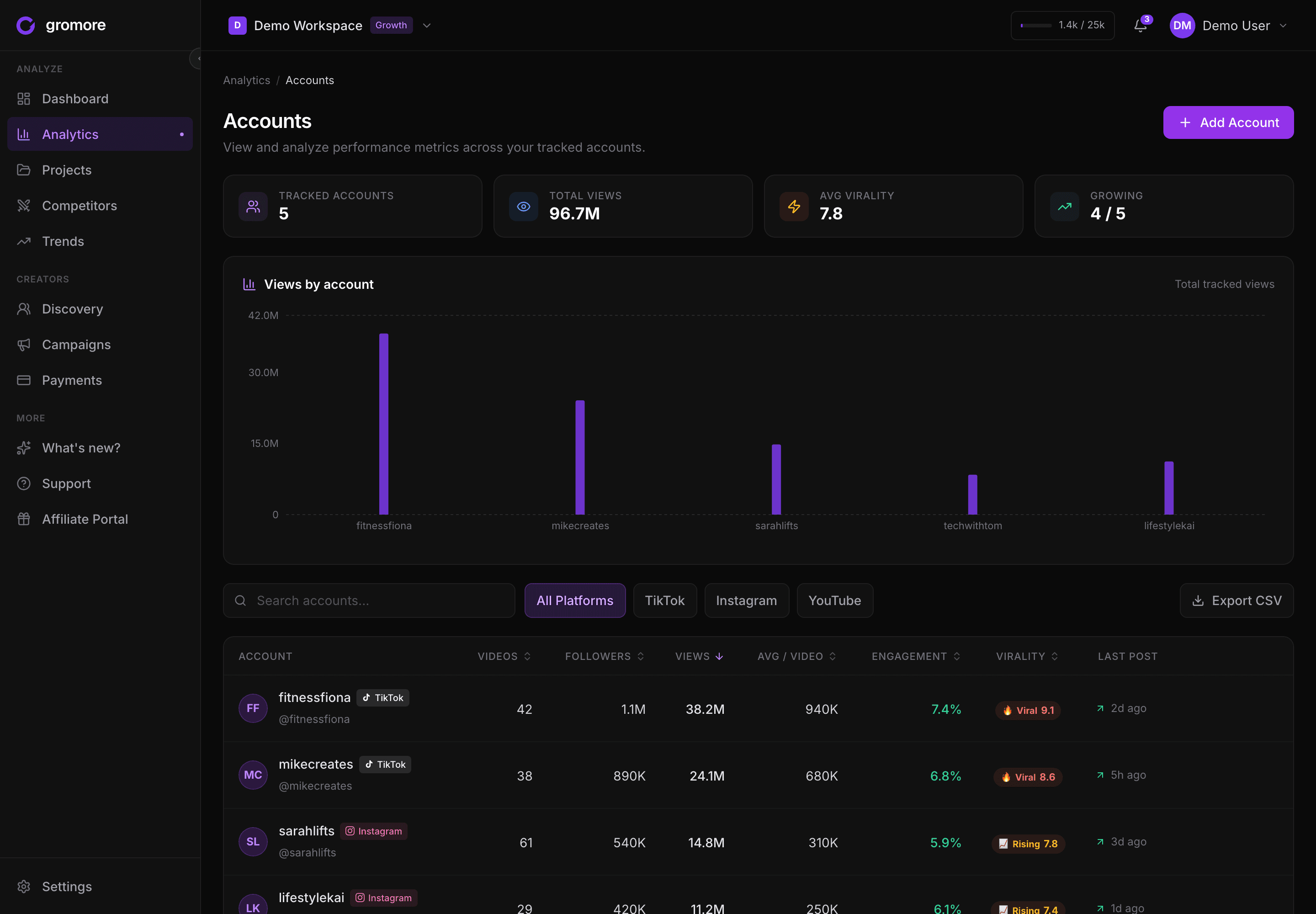
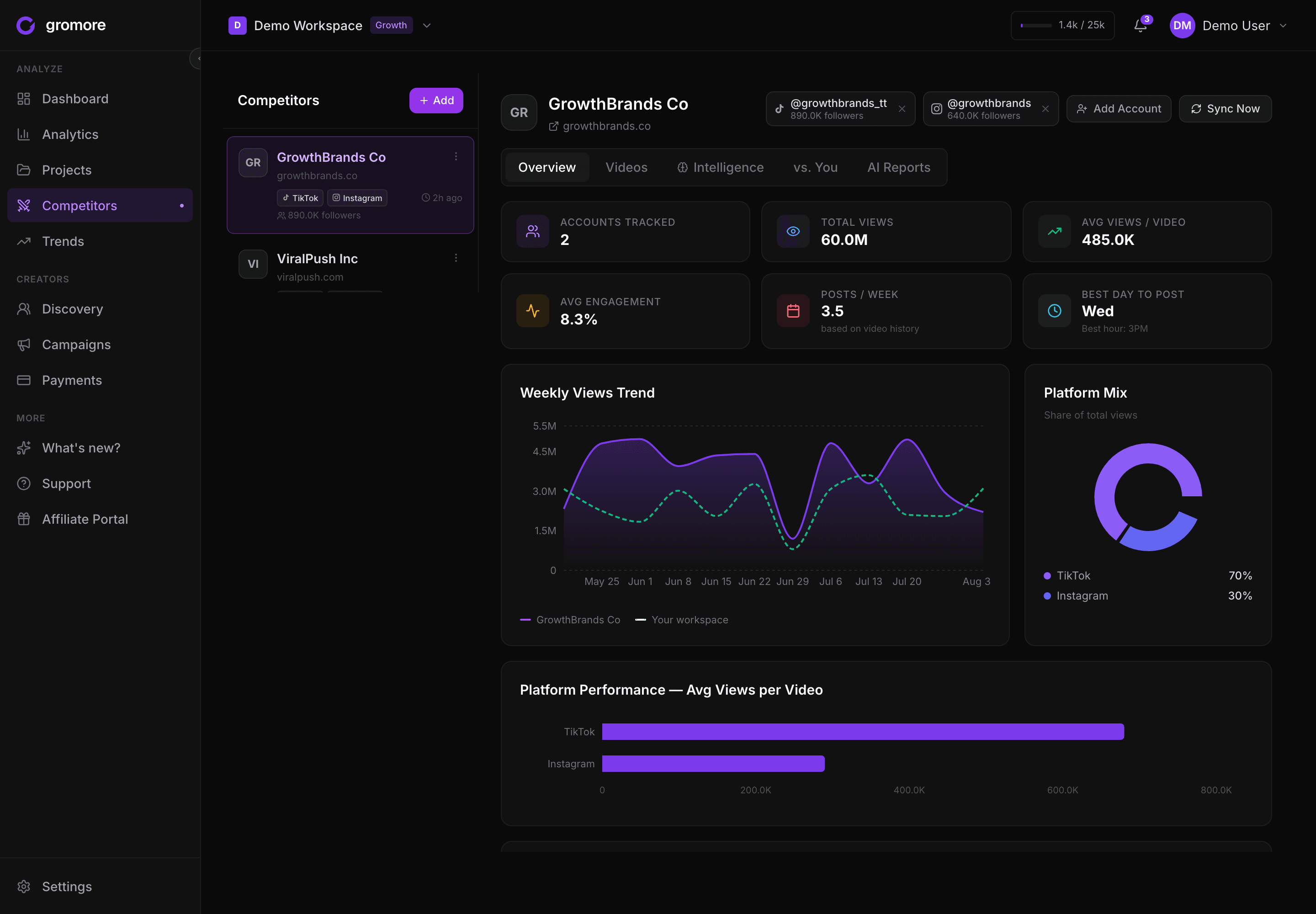
Gromore was purpose-built for the problem most Shopify marketers face: creator content is scattered across TikTok, Instagram, YouTube, and Facebook, and no single dashboard ties it together with campaign management, creator payments, and competitive intelligence.
Pros:
- True cross-platform tracking — TikTok, Instagram Reels, YouTube Shorts, and Facebook in one unified view.
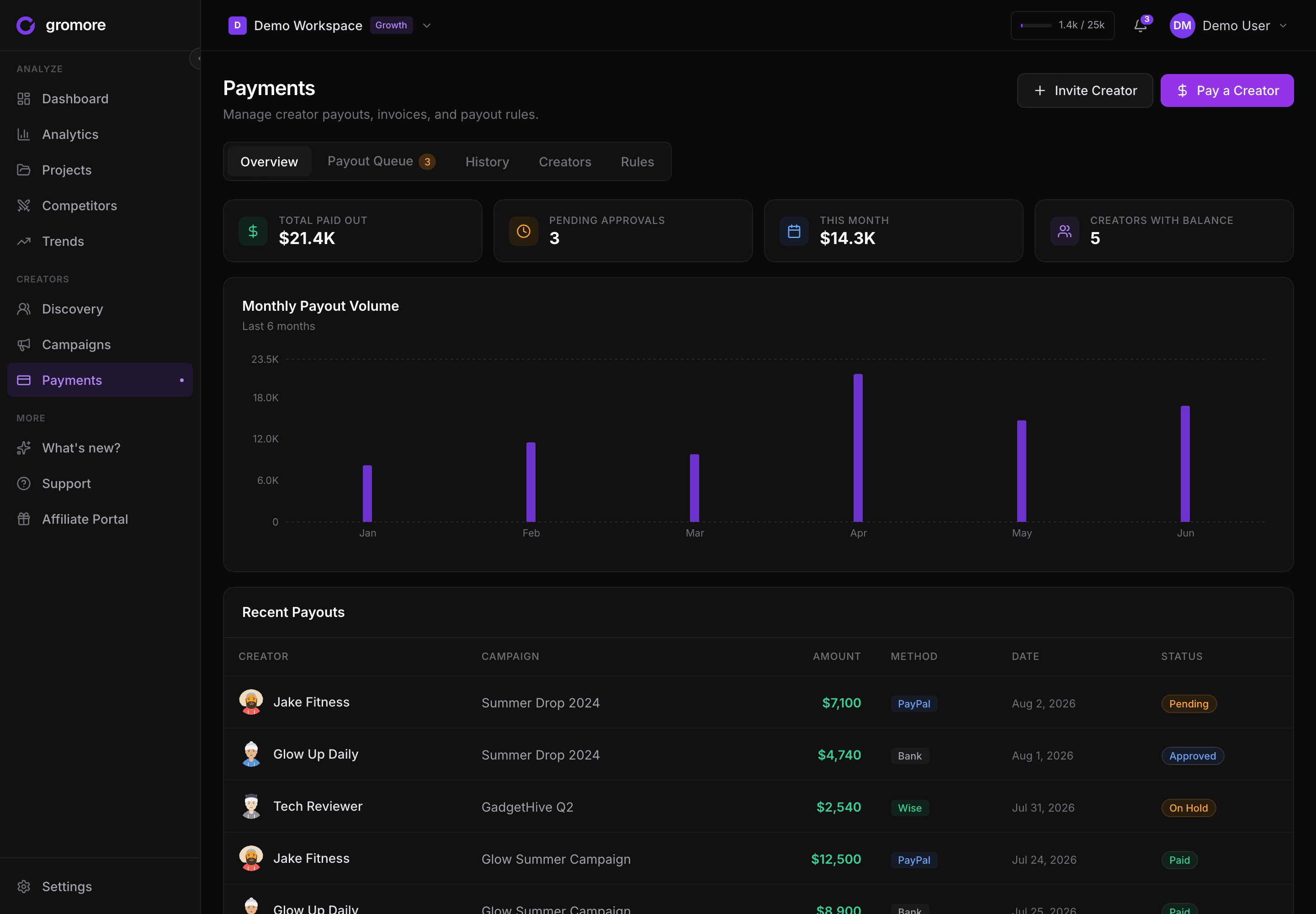
- Campaign management + creator payments — Assign briefs, track deliverables, and pay creators without leaving the platform.
- AI-powered competitor analysis — See which UGC formats and creators are working for rival Shopify brands in your niche.
- Trend alerts — Get notified when trending formats or sounds are relevant to your product category.
- White-label option — Agencies managing multiple Shopify clients can rebrand the dashboard.
- Pricing that respects D2C margins — Substantially cheaper than Sideshift ($199/mo) and viral.app's Ultra tier ($239/mo). Check Gromore pricing for current plans.
Cons:
- No native creator marketplace (you bring your own creators or source externally).
- Newer entrant, so brand recognition is still growing compared to legacy influencer platforms.
Verdict: Gromore hits four out of five criteria — cross-platform discovery, performance analytics, campaign management, and competitor benchmarking — at a price point that makes sense for Shopify brands doing $500K–$50M in annual revenue. It's our top pick.
4. Shortimize
Price: Launch plan at $99/mo
Best for: Brands focused primarily on short-form video analytics
Shortimize offers solid analytics for short-form video content. Its dashboards are clean and the data refresh rate is fast.
Pros:
- Strong short-form video analytics.
- Clean, intuitive interface.
- Competitive starting price at $99/mo.
Cons:
- Narrower feature set — analytics-focused without robust campaign management or creator payments.
- Limited competitor analysis capabilities compared to Gromore.
- No white-label option for agencies.
Verdict: A competent analytics tool, but you'll likely need supplementary software for campaign workflows and payments — which drives total cost higher.
5. viral.app
Price: Pro $79/mo, Ultra $239/mo
Best for: EU-based brands wanting UGC analytics with a European data footprint
Germany-based viral.app has built a respectable analytics platform, especially for TikTok and Instagram tracking.
Pros:
- Affordable entry at $79/mo (Pro).
- EU-headquartered, which can simplify GDPR compliance conversations.
- Decent TikTok analytics.
Cons:
- No creator marketplace.
- The feature gap between Pro ($79) and Ultra ($239) is steep — most Shopify brands will find the Pro plan limiting quickly.
- Campaign management is basic compared to Gromore or Sideshift.
Verdict: Reasonable entry-level option, but the Ultra tier's $239/mo price tag puts it in direct competition with tools that offer more functionality.
Tier 3: Mid-Range and Premium Tools ($150/mo+)
6. Sideshift
Price: Starter at $199/mo
Best for: Shopify brands that want a built-in creator marketplace alongside tracking
Sideshift differentiates by bundling a creator marketplace with its analytics and campaign tools. If sourcing creators is your biggest bottleneck, this integration has real value.
Pros:
- Built-in creator marketplace — find, vet, and book creators without leaving the platform.
- Solid campaign management features.
- Decent cross-platform tracking.
Cons:
- $199/mo starting price is 2–3x more expensive than Gromore for comparable analytics.
- Marketplace quality varies — you still need to vet creators carefully.
- No AI-powered competitor analysis.
Verdict: Worth considering if creator sourcing is your primary pain point. If you already have a creator roster, you're paying a premium for a feature you won't use.
7. Aspire (formerly AspireIQ)
Price: Custom (typically $2,000+/mo for Shopify brands)
Best for: High-growth Shopify brands spending $50K+/mo on influencer and UGC campaigns
Aspire is the enterprise incumbent. It offers end-to-end influencer relationship management, content tracking, and robust Shopify integration via its e-commerce module.
Pros:
- Deep Shopify integration with product seeding and affiliate tracking.
- Large creator database.
- Enterprise-grade reporting and compliance tools.
Cons:
- Pricing starts at roughly $2,000/mo — out of reach for most sub-$10M Shopify brands.
- Onboarding can take weeks.
- Over-engineered for brands running fewer than 20 creators.
Verdict: Best-in-class for brands with six-figure influencer budgets. Overkill and overpriced for everyone else.
8. Later (formerly Later + Mavrck)
Price: Growth plan from $40/mo; influencer features on higher tiers ($133+/mo)
Best for: Brands that want social scheduling and basic UGC tracking in one tool
Later merged with Mavrck to combine social media scheduling with influencer management. The UGC tracking features sit within its influencer module.
Pros:
- Combines content scheduling with creator management — fewer tools to juggle.
- Affordable entry point for basic scheduling.
- Visual content calendar is genuinely best-in-class.
Cons:
- UGC tracking is a bolt-on, not the core product. Depth of analytics can't match dedicated tools like Gromore or Shortimize.
- Influencer features only unlock on pricier tiers.
- Cross-platform UGC discovery is limited.
Verdict: A good two-in-one if social scheduling is also on your wishlist. As a pure UGC tracking tool for Shopify, it falls short of purpose-built alternatives.
Quick Comparison Table: UGC Tracking Tools for Shopify (2026)
| Tool | Starting Price | Cross-Platform Tracking | Campaign Mgmt | Creator Payments | Competitor Analysis | Shopify Fit |
|---|---|---|---|---|---|---|
| Native Analytics | Free | ❌ (siloed) | ❌ | ❌ | ❌ | ⭐ |
| DIY (UTM + Alerts) | Free | ❌ | ❌ | ❌ | ❌ | ⭐⭐ |
| Gromore | Free / Low paid | ✅ | ✅ | ✅ | ✅ (AI) | ⭐⭐⭐⭐⭐ |
| Shortimize | $99/mo | Partial | Basic | ❌ | Limited | ⭐⭐⭐ |
| viral.app | $79/mo | Partial | Basic | ❌ | ❌ | ⭐⭐⭐ |
| Sideshift | $199/mo | ✅ | ✅ | ✅ | ❌ | ⭐⭐⭐⭐ |
| Aspire | ~$2,000/mo | ✅ | ✅ | ✅ | ✅ | ⭐⭐⭐⭐ |
| Later | $40/mo | Limited | ✅ | Partial | ❌ | ⭐⭐⭐ |
How to Choose the Right UGC Tool for Your Shopify Store
Picking a UGC tracking tool comes down to three variables:
1. Number of Active Creators
Running one to five creators? Native analytics or the DIY UTM stack will hold up. Ten or more? You need a purpose-built platform. According to Influencer Marketing Hub's 2025 benchmark report, brands working with 10+ creators see a 38% increase in content output consistency when they use dedicated campaign management tools versus ad-hoc methods.
2. Platforms Your Creators Use
If your UGC is exclusively on TikTok, a TikTok-focused tool might suffice. But 73% of D2C Shopify brands now run UGC campaigns across at least two platforms (Statista, 2025). Cross-platform tracking isn't a luxury — it's a baseline requirement.
3. Budget Relative to Revenue
A common rule of thumb: allocate 5–15% of your influencer/UGC campaign budget to tooling. If you're spending $3,000/mo on creator fees, a $200–$400/mo tool is proportionate. If you're spending $500/mo, Gromore's pricing makes significantly more sense than Sideshift or Aspire.
Why Gromore Is Our Top Pick for Shopify Brands in 2026
We're transparent: Gromore is our product. But we built it specifically because we saw Shopify marketers overpaying for bloated enterprise tools or under-serving themselves with free analytics that couldn't scale.
Here's why we believe Gromore deserves the top spot:
- Full cross-platform coverage — TikTok, Instagram, YouTube, and Facebook in one dashboard.
- Campaign management + payments — No more toggling between a spreadsheet, a Slack channel, and PayPal.
- AI competitor analysis — Understand what UGC strategies your Shopify competitors are running before you spend a dollar.
- Trend alerts — Catch emerging formats and sounds early, so your creators ride trends rather than chase them.
- Agency-ready white-label — If you manage UGC for multiple Shopify brands, you can rebrand the entire dashboard.
- Priced for D2C margins — Substantially less than Sideshift ($199/mo), viral.app Ultra ($239/mo), and an order of magnitude less than Aspire.
If that sounds like a fit, start a free trial and test it against your current workflow.
What is the best free UGC tracking tool for Shopify?
The best free option is combining native platform analytics (TikTok, Instagram, YouTube) with UTM-tagged links that feed into Shopify's built-in analytics. This gives you basic attribution at zero cost, though it requires significant manual effort and won't scale past a handful of creators.
Does Gromore integrate with Shopify?
Gromore is designed with Shopify brands in mind. It supports UTM-based attribution that works seamlessly with Shopify analytics, and its pricing is structured for the margins typical of D2C ecommerce. Visit Gromore features for full integration details.
How much should a Shopify brand spend on UGC software?
A common benchmark is 5–15% of your total influencer or UGC campaign budget. For a brand spending $3,000/mo on creator fees, that's $150–$450/mo on tooling. Gromore falls well within this range for most Shopify merchants.
Can I track UGC across TikTok, Instagram, and YouTube in one tool?
Yes. Gromore, Sideshift, and Aspire all offer cross-platform UGC tracking across TikTok, Instagram, YouTube, and (in Gromore's case) Facebook. Gromore is the most affordable option that covers all four platforms with AI-powered analytics.
What's the difference between UGC tracking tools and influencer marketing platforms?
UGC tracking tools focus on monitoring and analysing content created about your brand, whether by paid creators or organic customers. Influencer marketing platforms (like Aspire) emphasise creator discovery, relationship management, and large-scale campaign orchestration. Many modern tools, including Gromore, blend both functions.
Is UGC tracking worth it for small Shopify stores?
Absolutely. A 2025 Bazaarvoice study found that UGC-driven shoppers convert at a 161% higher rate. Even small stores running two or three creators benefit from structured tracking — it tells you which content drives sales and which doesn't, so you can allocate budget smarter.
How does Gromore compare to Sideshift and viral.app?
Gromore offers cross-platform tracking, campaign management, creator payments, and AI-powered competitor analysis at a lower price point than both Sideshift (from $199/mo) and viral.app Ultra ($239/mo). Sideshift's advantage is its built-in creator marketplace; viral.app's advantage is its EU data footprint. For most Shopify brands, Gromore delivers more functionality per dollar.
Conclusion: Stop Guessing, Start Tracking
UGC is no longer a "nice to have" for Shopify brands — it's a conversion engine. The right tracking tool turns scattered creator content into actionable data: which videos drive traffic, which creators deliver ROI, and which platforms deserve more budget.
For the majority of D2C Shopify brands, Gromore offers the strongest combination of cross-platform analytics, campaign management, and competitive intelligence at a price point that won't wreck your margins. Whether you're running five creators or fifty, having a single dashboard that ties everything together is the difference between scaling smart and scaling blind.
Ready to track your UGC like a real D2C brand? Start your free Gromore trial today and see which creator content is actually driving Shopify revenue.