Short answer: To pay a UGC creator, agree the price and scope, put it in a short written contract, take a deposit (50% upfront is standard), then send the balance on delivery through a payment rail you both pick — ACH or bank transfer domestically, Wise or Payoneer for international creators, PayPal when speed matters. A tool like Gromore calculates and records what's owed and routes approvals; the money itself always moves through the rail you choose, not the tool.
Paying a UGC creator sounds like it should be the easy part. You've found someone good, agreed they'll make three videos, and now you just... send money? For a lot of first-time UGC buyers, this is exactly where it gets awkward — nobody publishes the norms, so you're left guessing whether a deposit is reasonable, which app to use, and what happens at tax time.
Here's the reassuring news: there is a standard way to do this, most experienced creators expect it, and following it is the fastest route to a working relationship and repeat content. This guide walks the whole mechanics end to end — the process, the contract, the deposit, the payment rails, and the mistakes that quietly torch creator relationships. We'll keep the how-much light on purpose and link out to the rate breakdowns; this post is about what happens once you've agreed the number.
The standard way to pay a UGC creator, step by step
Almost every clean UGC deal follows the same five beats:
- Agree the price. Settle the number and the scope before anything else — how many videos, which platforms, how many revisions, and whether usage rights cost extra. If you're still working out the figure, see how much to pay UGC creators and the different creator payout structures like flat rate, CPM, and milestone bonuses. This post assumes you've landed on a number.
- Lock it in a contract. Even a one-page agreement is fine. It doesn't need a lawyer — it needs the deliverables, dates, amount, and rights written down somewhere both of you can point to later.
- Collect a deposit. Typically 50% up front, the balance on delivery. More on why that's normal below.
- Deliver and review. The creator sends the work; you review it against the brief inside an agreed window. Revisions happen here — within the scope you agreed, not an open-ended loop.
- Send final payment — and record it. On approval, the creator invoices (or you log the payout), you release the balance through your chosen rail, and you keep a record of what was paid, to whom, for which deliverable.
That last half-sentence matters more than it looks. Whatever tool you use to figure out and approve a payout, the money itself always moves through a payment rail you pick — a bank transfer, PayPal, Wise. Keep the two ideas separate from day one: deciding and recording what's owed is one job; moving the money is a different one.
What goes in the contract — and where disputes actually start
You don't need a fifteen-page master agreement for a $400 video deal. You do need something written, because the alternative — a DM thread and good vibes — is exactly where money disputes come from. A workable UGC contract covers:
- Deliverables — number of videos, length, platform, format, and any raw-footage handoff.
- Timeline — draft date, revision window, final delivery.
- Payment amount and schedule — total, deposit, balance, and the trigger for each.
- Accepted payment method — name the rail up front so there's no scramble on delivery day.
- Late-fee / kill-fee policy — what happens if either side slips or the project dies mid-way.
- Usage rights — the clause that actually causes fights.
Spell out usage rights in particular, because "we'll use the videos" is not a rights grant — it's a future argument. Are you licensing the content for organic social only, or for paid ads too? For how long — 30 days, a year, in perpetuity? On which channels? Can you edit or re-cut it? A creator who charges more for a 12-month paid-ads license than a 30-day organic one is being professional, not difficult. Pay for the scope you actually need, and get that scope in writing.
Why a 50% deposit is standard, not a red flag
If a creator asks for 50% up front, that's the industry norm, not a scam signal. First-time buyers often flinch at this, so it's worth saying plainly: a deposit protects the creator, and a creator who asks for one is usually the professional you want.
Look at it from their side. They're an individual — often a sole proprietor — about to block out days of filming and editing for someone they've never worked with. A deposit does two things: it filters out non-serious brands who were never really going to pay, and it compensates the creator for committing time before any final content exists. It quietly protects you, too — a creator with skin in the game via a signed deal and a booked deposit is more likely to deliver on schedule.
The default split is 50% on signing, 50% on delivery and approval. For a larger or longer engagement you might see milestone splits — a third on signing, a third on first drafts, a third on final — which is the same principle stretched across a bigger scope.
Payment methods compared: ACH, PayPal, Wise, and payout platforms
There's no single "best" rail. The right one depends on where the creator is, how fast they need the money, and how much you're willing to lose to fees. Here's how the common options stack up — treat the specifics as rough guidance, because fees and speeds change constantly and vary by country and account type:
| Method | Typical cost | Typical speed | Best for |
|---|---|---|---|
| Bank transfer / ACH | Lowest — often free to around a dollar | ~1–3 business days | Domestic creators you pay repeatedly |
| PayPal | Higher — a percentage per transaction | Near-instant | Speed, and creators who already use it |
| Wise / Payoneer | Low FX margin plus a small fee | ~Same day to a couple of days | International creators |
| Marketplace / escrow (Collabstr-style) | A platform fee on top | Held until delivery | First-time buyers who want protection |
A few notes beyond the table:
- Bank transfer / ACH is usually cheapest for domestic creators and scales well once you're re-hiring the same faces. The tradeoff is setup — you need their bank details, and the first transfer can feel slow. Ideal for a roster you pay again and again.
- PayPal wins on convenience and speed; most creators already have an account. Watch the fees — it typically takes a percentage per transaction, and "Goods & Services" payments cost more than "Friends & Family." Don't be tempted to use Friends & Family for commercial work: it strips the buyer/seller protection that's the whole point. PayPal also carries dispute and chargeback exposure that a plain bank transfer doesn't.
- Wise and Payoneer are the workhorses for international creators. They're widely cited for landing close to the mid-market exchange rate with modest fees, which usually beats a raw international wire from your bank. The catch is that the creator needs an account on their end.
- Marketplace / escrow platforms hold the money until the work is delivered — the safest option for a nervous first-time buyer. You pay for that safety with a platform fee, and you're operating inside their ecosystem rather than paying the creator direct.
Confirm the current fee and timing before you commit to any of these. None of the numbers are stable, and the right pick for a $200 domestic gig is rarely the right pick for a €2,000 cross-border one.
Payment terms: due-on-receipt vs Net-15 vs Net-30
Payment terms are simply when the balance is due after you've approved the work:
- Due on receipt — payment the moment the invoice lands (or on approval). Friendliest to creators, and the norm for smaller UGC deals.
- Net-15 — due within 15 days. A reasonable middle ground that gives your bookkeeping a small buffer.
- Net-30 — due within 30 days. Standard in big-company procurement, but usually too slow for UGC.
Here's what brands from a corporate background get wrong: Net-30 is fine when you're paying another business that has cash reserves and an invoicing department. A UGC creator is usually an individual who just fronted days of work on a 50% deposit. Making them wait a month for the balance is a fast way onto their "slow payer" list — and in the tight, chatty world of creator communities, that reputation travels. For UGC, default to due-on-receipt or Net-15. If you genuinely need Net-30, say so up front and expect some creators to price it in.
Paying international creators: what actually changes
Paying a creator in another country is completely normal — the UGC talent pool is global — but a few things shift, and it's the section most guides gloss over:
| What changes | What to do about it |
|---|---|
| Currency | Agree the invoice currency up front, and decide who absorbs the FX cost |
| Payout rail | Wise, Payoneer, or PayPal usually beat a raw international wire |
| Tax forms | Collect a W-8BEN (or the local equivalent) instead of a W-9 |
| Timing | Build in a buffer — cross-border transfers can take longer to land |
The big one is tax paperwork, and it trips up new buyers. In the US, the rough shape is this: you generally collect a W-9 from US-based creators and a W-8BEN from non-US creators to document their status, and you may need to file a 1099-NEC for a US contractor you pay above the IRS reporting threshold in a year. Payments routed through third-party platforms like PayPal can be reported differently again. These rules have shifted recently and the thresholds move, so treat this as a prompt to check current requirements with an accountant — it isn't tax advice. The one durable habit: collect the right form before you send the first payment, not at tax time when the creator has long since moved on.
Mistakes that quietly cost you creators
Most damaged creator relationships don't come from a blowup — they come from small, avoidable process failures. The big three:
- Paying late. The number-one relationship-killer. Worth being blunt about — more below.
- Working without a contract. "We agreed in the DMs" holds up fine until it doesn't: a dropped deliverable, a rights dispute, a scope disagreement. A one-page agreement is cheap insurance against all three.
- Blurring revisions and scope creep. Your contract said two rounds of revisions. Asking for a "quick tweak" for the fifth time is a new scope, and treating it as free is how you sour a creator on ever working with you again. Define what a revision is — fixing something inside the agreed brief — versus a new request — a different hook, extra videos, a re-shoot — and pay for the second kind.
What paying late actually costs you. It's tempting to treat a slipped payment as a minor admin thing. It isn't. UGC creators talk — the good ones run in tight Slack groups, Discords, and niche communities where "which brands actually pay on time" is a live, ongoing conversation. Stiff one creator and you're not only losing them; you're quietly losing the ones they'd have referred, and buying a reputation that makes your next round of outreach slower and more expensive. Your best creators are proven, hard to replace, and completely free to walk. Churning them over a payment you could have sent on time is the most expensive kind of cheap. Paying reliably, on the terms you agreed, is one of the highest-ROI things a UGC program does — it turns a one-off shoot into a roster that keeps making content for you.
Where Gromore fits: the "what to pay," not the money
Once you're paying more than a couple of creators, the hard part stops being the transfer and becomes keeping track of what you owe, to whom, for which deliverable, and whether it's been approved. That's the half a spreadsheet handles badly and a payment app doesn't handle at all.
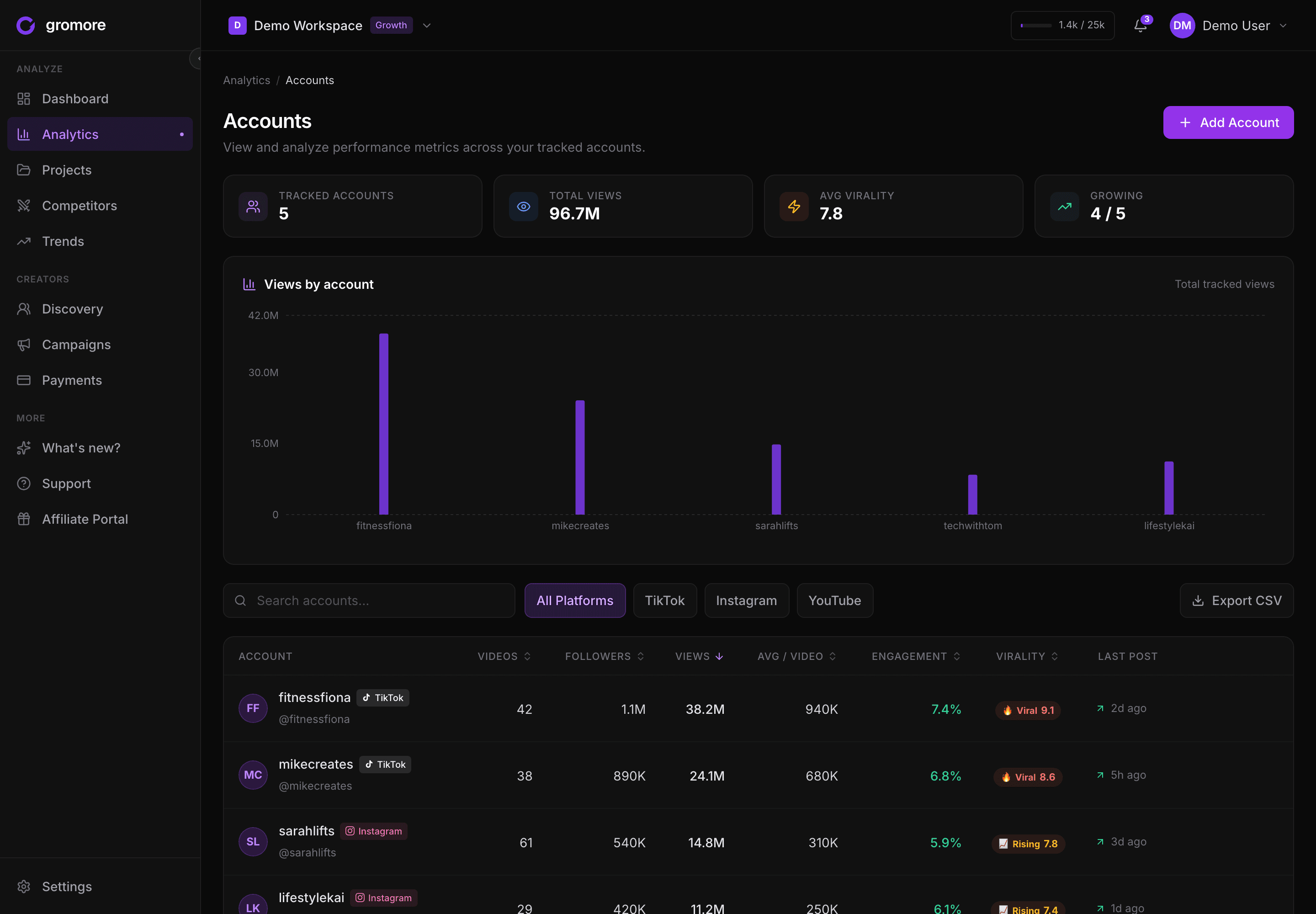
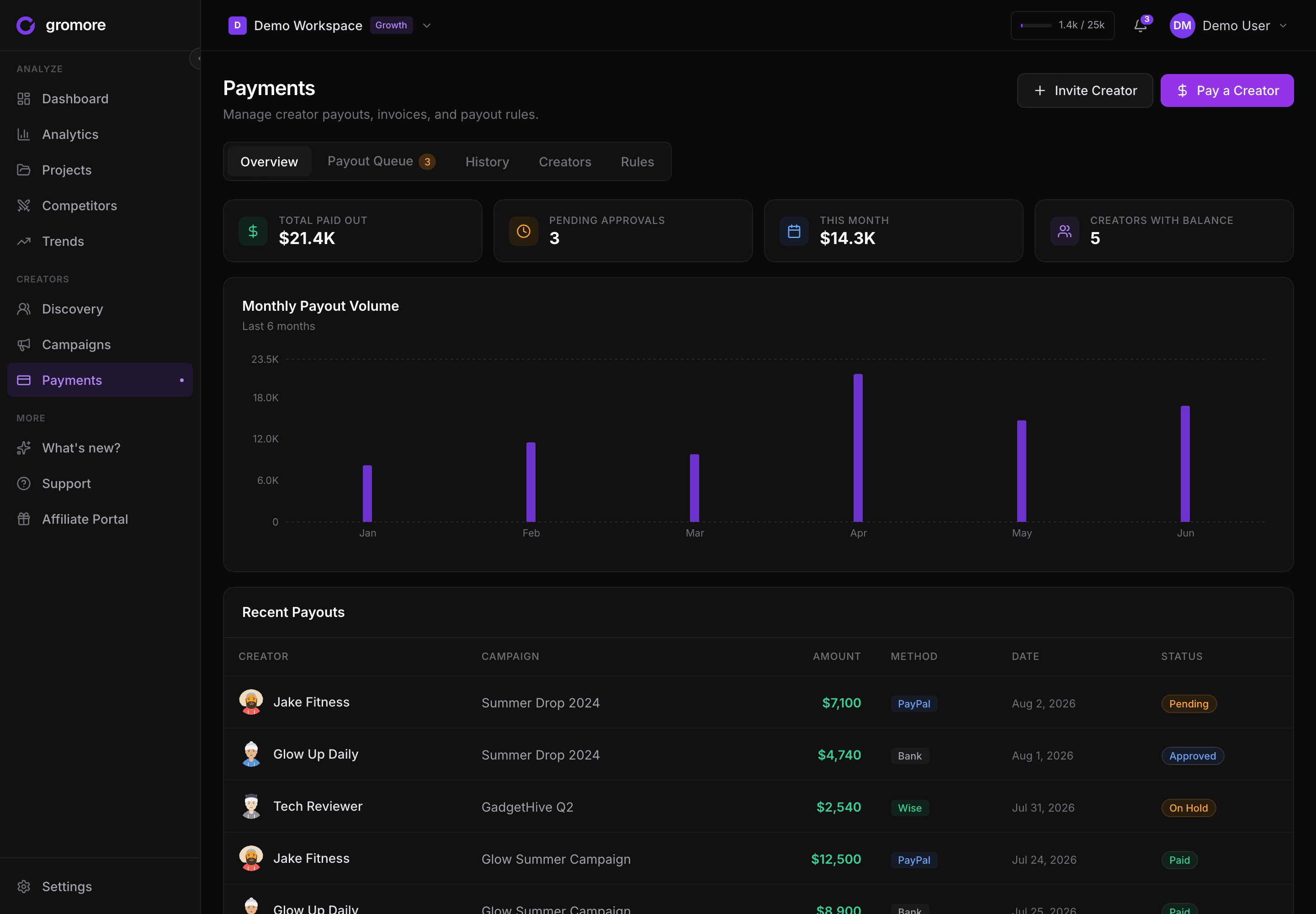
This is the specific job Gromore does — and it's worth being precise about the boundary. Gromore is record-mode: it calculates what each creator is owed from your payout rules (a base rate, a CPM on views, milestone bonuses, or a mix), routes the payout through an approval workflow so a second person signs off before anything is marked paid, and keeps a clean, auditable record of every payout tied to the campaign and the creator's actual performance.
What Gromore does not do is move the money. It doesn't send payments, hold funds, or act as a payment processor. When a payout is approved, you send it through whatever rail you already chose — PayPal, Wise, ACH, your bank — and mark it paid in Gromore so the record stays straight. Split the task cleanly in your head: Gromore owns what to pay, who approved it, and the record; your payment rail owns the transfer. (If you want the money movement itself automated end to end, that's a different category of tool — see automate creator payments.)
Because the payout math is wired to the same UGC analytics that track each creator's views and performance, "what do we owe this creator" stops being a monthly spreadsheet reconciliation and becomes a number you can already see — which, not coincidentally, is the single best defense against the late-payment mistake above.
Bottom line
Paying UGC creators well isn't complicated, but it is a process: agree the number, put it in a short contract, take a 50% deposit, deliver and review, then send the balance promptly through a rail that fits the creator — ACH or bank for domestic regulars, Wise or Payoneer across borders, PayPal when speed wins. Sort the paperwork and the tax forms before the first payment, keep terms short, and treat on-time payment as the relationship-building tool it actually is. The transfer is the easy part; the discipline that keeps creators coming back is knowing exactly what's owed, approving it cleanly, and recording it every single time.
Want every creator payout calculated, approved, and recorded in one place — without the spreadsheet? Start a free 7-day Gromore trial — no card required.