Short answer: Almost every modern creator payout is built from three pieces — base pay (a guaranteed fee per video), CPM bonuses (paid per 1,000 views), and milestone bonuses (paid when a specific result is hit). Most 2026 D2C programs combine all three: a small predictable base, a CPM ladder that rewards reach, and the occasional milestone bonus for a breakout.
If you're building a UGC creator program, "how much do I pay?" is the wrong first question. The right one is how do I structure the payment — because the structure decides whether creators are motivated to perform, whether your costs stay predictable, and whether your best creators stick around.
Get it right and a creator's incentives line up with your revenue. Get it wrong and you either overpay for flops or underpay your winners until they leave. Here's the framework — base vs CPM vs milestone — with representative 2026 ranges and a worked example that shows how they combine.
Why one flat rate doesn't work for most D2C creator programs
The instinct is to pay a flat fee per video. It's simple, but it breaks at both ends:
- Pure flat fee = the creator gets paid the same whether the video does 2,000 views or 2 million. There's no reason for them to push, and you carry all the risk.
- Pure commission (only pay on performance) = the creator carries all the risk, their income swings wildly month to month, and your best creators leave for brands that offer stability.
The structures below exist to split that risk sensibly — a guaranteed floor for the creator, upside for the brand when content performs.
Base pay: the guaranteed floor
Base pay is a fixed fee the creator earns per video (or per week), regardless of views. It's the predictability layer.
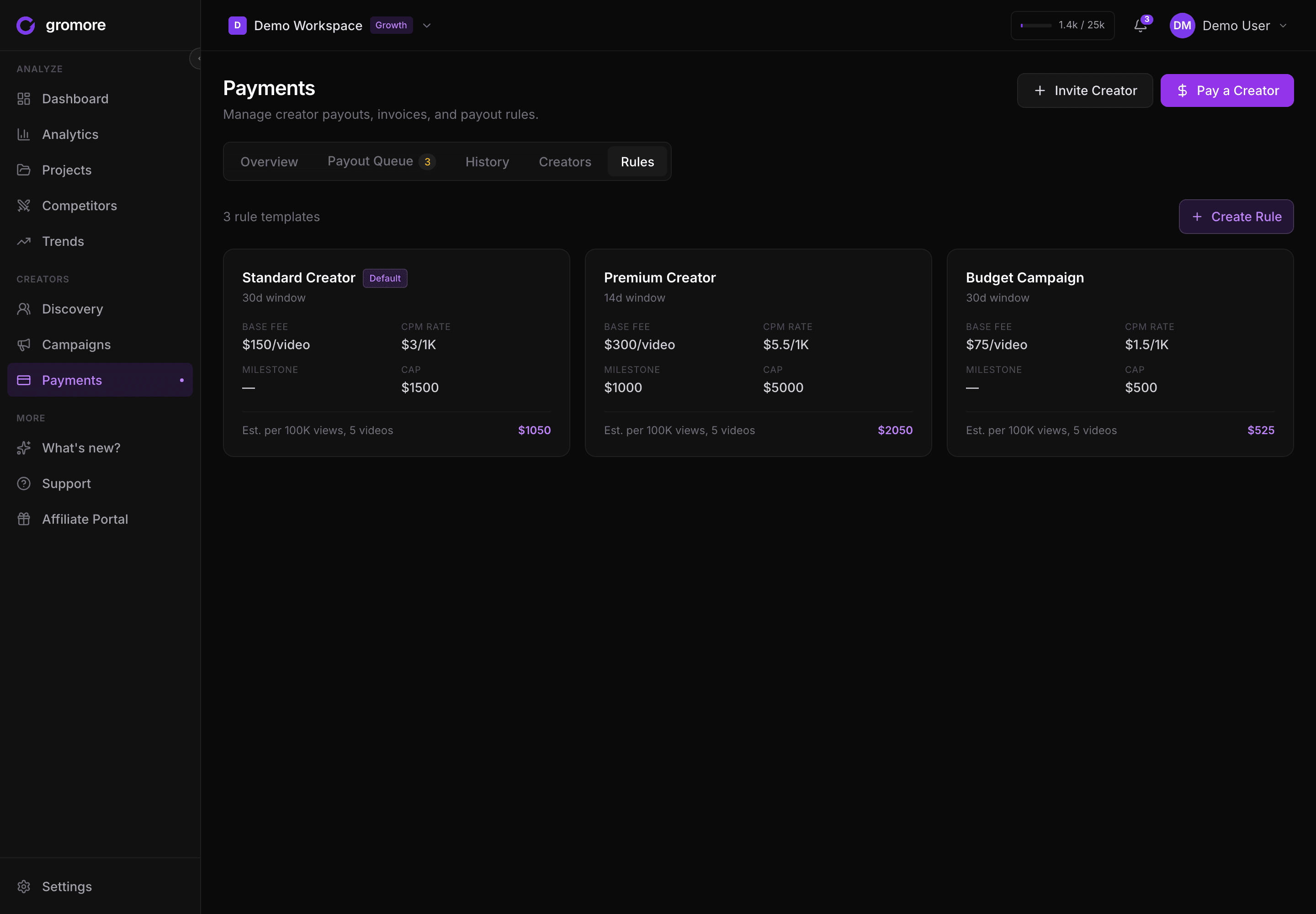
- Representative range: commonly $75–$300 per video, depending on creator size and how produced the content is — a high-volume budget creator sits near the low end, a premium creator with a real production setup near the top. At a $150 base and ~5 posts a week, that's roughly $750 a week guaranteed before any performance pay.
- Why it matters: even in a performance-heavy model, creators need a reliable baseline to justify showing up consistently. Cut the base too low and you'll only attract creators treating you as a side experiment.
- It varies by niche and creator size. A skincare micro-creator and a tech reviewer with a produced setup aren't the same line item. Use the range as a starting anchor, then set the base per creator rather than forcing one flat rate across your whole roster.
Base pay alone won't make anyone chase a viral hook — which is where the next two layers come in.
CPM-based view bonuses
CPM ("cost per mille") pays the creator a set dollar amount per 1,000 views the content earns. It's the layer that rewards reach.
- How it works: pick a rate — typically $1.50–$5.50 per 1,000 views for D2C UGC, with around $3 a common middle — and the creator earns it on the views their videos generate.
- Staggered ladders: many brands don't pay a flat CPM on view one. Instead they set a ladder that unlocks at thresholds — for example bonuses triggered as a video crosses 10K → 50K → 100K → 500K → 1M views — so payouts scale with genuine breakouts rather than baseline reach.
- Where it tops out: ladders usually cap somewhere around 1–2M views so a single freak-viral video doesn't blow your monthly budget.
One nuance worth building in: a view isn't the same thing on every platform. TikTok counts a view almost the instant a video starts; Instagram and YouTube measure it differently. If you pay a single blended CPM across all three, you'll systematically overpay on whichever platform has the loosest view definition. Either set a per-platform CPM, or pick one platform's view count as your basis and normalize the rest.
CPM ties spend directly to the outcome you actually care about — eyeballs on the product.
Milestone bonuses
Milestone bonuses are event-based, not time-based: you pay when a defined result happens, not on a schedule.
- How it works: define the milestone — a video crossing 500K views, a campaign hitting an aggregate view target, a product selling out — and attach a one-time bonus to it.
- Best for: launch campaigns, seasonal pushes, and rewarding a single asset that outperformed. They're a clean way to say "hit this specific thing and there's extra on top."
Milestones are the spice, not the meal — used occasionally on top of base + CPM.
The hybrid model (the actual 2026 norm)
In practice, serious programs combine all three: a modest base for predictability, a CPM ladder for reach, and the odd milestone bonus for standout results.
Here's one creator over one month to make it concrete (illustrative numbers — adjust to your own rates):
| Component | Detail | Payout |
|---|---|---|
| Base pay | 4 videos × $150 | $600 |
| CPM bonus | 230,000 total views × $3 / 1,000 | $690 |
| Milestone bonus | one video crossed 100K | $150 |
| Total for the month | $1,440 |
Notice how the pieces play different roles: the $600 base guaranteed the creator got paid to show up, the CPM rewarded the reach their videos actually earned, and the milestone paid out the one that broke 100K. This creator lands just under the rule's cap — if those same videos had gone viral and done 2M views, the CPM alone would blow past a $1,500 cap, which is exactly how that ceiling stops a breakout month from wrecking your budget.
Now run a quiet month for the same creator: four videos that manage just 90,000 views between them, no milestone. Base still pays $600, CPM adds $270, and they walk away with $870 — not a great month, but not zero. That floor is exactly why good creators stay through the slow weeks instead of chasing the next brand the moment a video underperforms.
How to decide which mix fits your brand
There's no single right ratio, but there is a rule of thumb tied to your program's stage:
- New program → lean base-heavy. You want predictable costs and reliable creators while you learn what works. A higher base and a modest CPM keeps things stable.
- Scaling program → lean CPM-heavy. Once you know your content converts, shift weight to CPM and milestones so you're paying for performance and your cost-per-view stays efficient as you grow.
The metrics you use to trigger all of this matter as much as the structure — see the UGC metrics D2C brands should actually track for which numbers belong in a payout formula (and which are vanity).
How Gromore's payout rules engine implements this
This base-plus-CPM-plus-milestone model isn't theoretical for us — it's exactly what Gromore's payout rules engine is built around.
You define the rules once: a base rate, a CPM (with laddered thresholds), and any milestone bonuses — with per-creator overrides and caps when a creator's deal is different. Because Gromore is already tracking each creator's video performance, it calculates what every creator is owed automatically from those rules, so you're never rebuilding a payout spreadsheet from view counts by hand.
One important thing to be clear about: Gromore calculates, tracks, and records payouts — it doesn't move your money. Amounts run through an approval workflow (with an audit trail of who approved what), and you pay out through your own method. You get the math, the structure, and the record-keeping; you keep full control of the actual transfer.
That's the piece most brands are missing — not a payment button, but a system that turns "which structure do I use?" into a rule the platform applies to real performance data, every cycle, without the spreadsheet.
A few common mistakes to avoid
- No base at all. Pure-performance pay reads as "we don't value your time" and pushes your most reliable creators to brands that offer a floor.
- A CPM with no cap. One freak-viral video can wreck a monthly budget — cap the ladder (commonly 1–2M views) so your upside stays bounded.
- Paying on the wrong metric. Bonuses tied to likes or follower count reward vanity. Tie them to views, saves, or attributed sales instead.
- Changing the deal mid-campaign. Lock the structure before creators post. Renegotiating after a video pops is the fastest way to lose a good creator's trust.
Bottom line
Don't pay creators a flat fee and hope. Combine a base for predictability, a CPM ladder for reach, and milestone bonuses for breakouts — weighted toward base when you're new and toward CPM as you scale. Then let a payout rules engine apply that structure to real performance so every creator's payout is calculated the same, fair way. For the full picture of tracking and paying creators, start with our guide to UGC analytics, or go deeper on how much to actually pay UGC creators and the payment methods to use.
Want your payout structure calculated automatically from real performance? Start a free 7-day Gromore trial — no card required — and set up base, CPM, and milestone rules in minutes.