Short answer: A UGC creator campaign runs as a five-stage loop — brief, outreach and contracting, content creation, review and approval, and payout. Most brands don't lose control inside any single stage; they lose it in the handoffs between them, where a name in a spreadsheet, a draft in an inbox, and a payment in a banking app never quite line up. The fix is to run the whole loop — brief → track → payout — in one place instead of four.
You can pick a great creator, get genuinely great content back, and still have the campaign feel like a mess — because the individual steps aren't the hard part. Briefing someone is easy; approving a video is easy; paying an invoice is easy. What's hard is the connective tissue: remembering which of your thirty creators is late, which draft you already signed off, whose video cleared the view threshold that triggers a bonus, and who you've actually paid.
This is a literal walkthrough of the whole loop, stage by stage, with the specific place each stage tends to break. Follow it top to bottom and you'll have a repeatable process — not just for one creator, but for the hundredth.
The 5-stage UGC creator campaign workflow, at a glance
Every UGC campaign — your first or your five-hundredth — runs the same five stages:
| Stage | What happens | What "done" looks like |
|---|---|---|
| 1. Brief | You tell the creator what to make, for which platform, and why | Creator knows the hook, the deliverable, and the deadline |
| 2. Outreach & contracting | You agree deliverables, timeline, usage rights, and the payment basis | Terms locked in writing before anyone shoots |
| 3. Content creation | The creator shoots, edits, posts — and you start tracking performance | Content is live and being measured across platforms |
| 4. Review & approval | You check the work against the brief and sign off (or request changes) | Deliverable marked approved, tied to its campaign |
| 5. Payout | You calculate what's owed, route it for approval, and record the payment | Amount computed, approved, paid, and logged |
The stages themselves are the easy part. Every leak in a UGC program happens in the handoffs — the moment a creator moves from "briefed" to "posted," or from "approved" to "owed money," and that information has to jump from one tool to another. Each jump is a chance to lose a draft, miss a deadline, or pay the wrong amount.
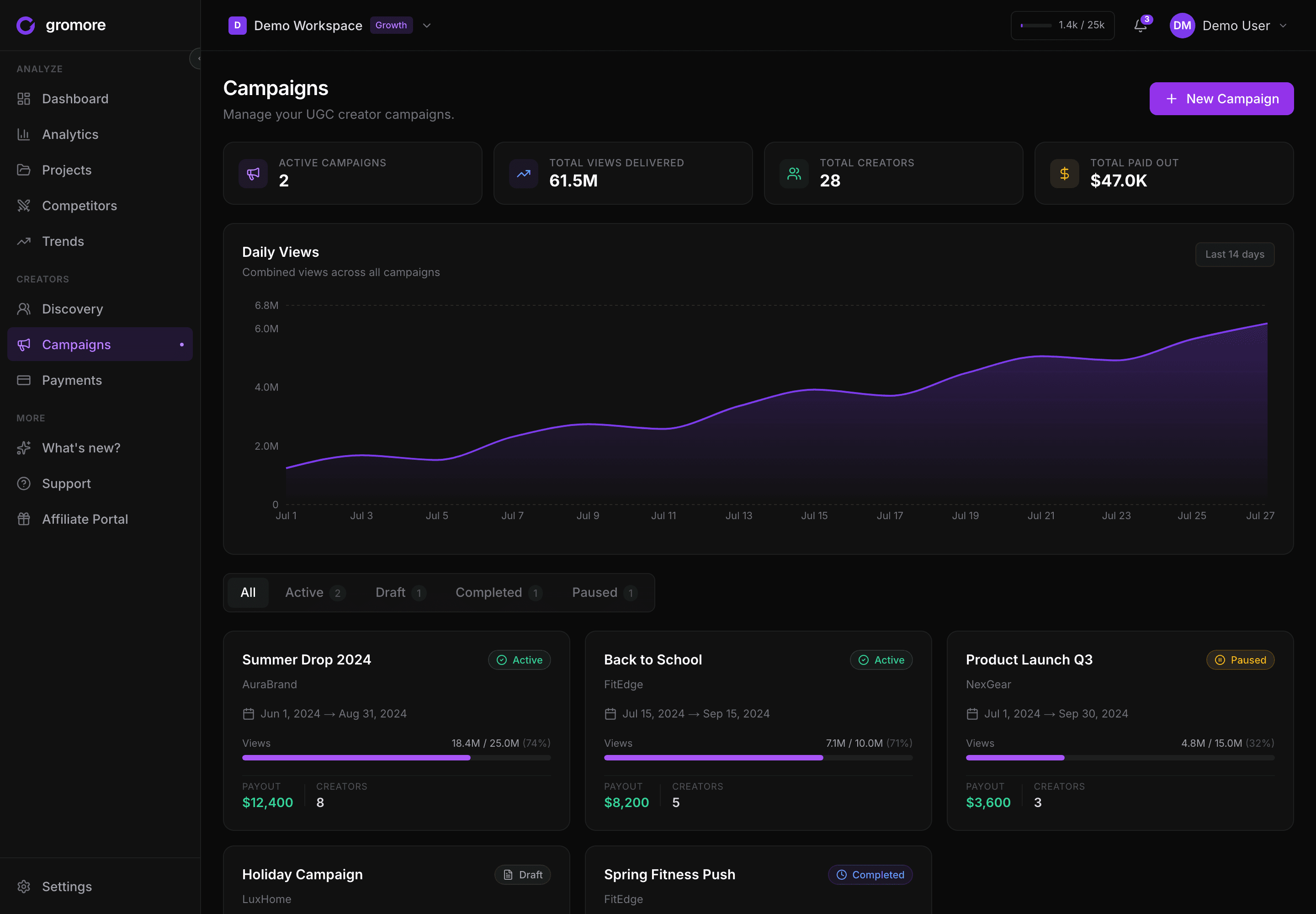
That's why Gromore frames campaign management as three words, not five: brief → track → payout. "Track" is the connective tissue in the middle — the running measurement of every posted deliverable that turns outreach and content into numbers you can approve and pay against. Purpose-built creator campaign management software exists to close those handoffs so nothing falls through them. Let's walk each stage.
Stage 1: Writing a brief that doesn't cause revision spirals
The instinct with a brief is to control everything — shot list, script word-for-word, exact captions. Resist it. You hired a creator because their audience trusts their voice, and a brief that scripts every second strips out the thing you're paying for. The better mental model is context over control: tell them what you're selling, who it's for, what makes it different, and which hook or angle you want them to lead with — then let them make it in their style.
A good UGC brief contains, at minimum:
- The one thing — the single message or benefit the video has to land. Not five features. One.
- The hook direction — the opening two seconds. Give an angle ("start mid-problem, not with the product"), not a line to recite.
- Deliverable spec — platform, format, count, and rough length (e.g. one 30–45s TikTok, vertical, plus the raw file for ads).
- Do's and don'ts — claims you legally can't make, competitors you won't name, the disclosure/#ad requirement.
- The timeline — both dates.
That last point is the one most brands get wrong, and it's the single most common operational failure in the whole workflow: they specify a go-live date but not a draft-submission date. "We need this live by the 15th" feels like a deadline. It isn't. If the creator posts a draft on the 14th and it needs one round of changes, you've already missed the 15th. Build the timeline backwards from go-live: if it's live on the 15th, drafts are due the 10th, which leaves real room to review, request one change, and re-approve without a panic. Put the draft date in the brief, in bold, and you've eliminated the most common reason campaigns run late.
Stage 2: Outreach, contracting & onboarding
Once you've picked your creators, the goal of this stage is boring on purpose: lock every term before a single frame is shot. Ambiguity here is what turns into a dispute at payout time.
Four things have to be agreed in writing:
- Deliverables — the exact count, platform, and format. "Three videos" is a fight waiting to happen; "three 30-second vertical TikToks plus raw files, posted to the creator's handle" is a contract.
- Timeline — the draft date and the go-live date, from Stage 1, written down.
- Usage rights — can you run the content as a paid ad? For how long? On which platforms? Whitelisting/Spark Ads permissions are cheaper to agree now than to renegotiate after a video pops.
- Payment terms — how much, on what basis, and when.
That last one deserves care, because how you pay shapes everything downstream. A flat fee is simplest. A performance structure — a base fee plus a CPM (an amount per 1,000 views) plus milestone bonuses — ties spend to results and rewards the creators who actually move the needle. Decide the model here, in the contract, so tracking and payout have something to measure against. If you're unsure what the number should be, our breakdown of how much to pay UGC creators and the deeper guide to creator payout structures walk through base, CPM, and milestone models with real math.
Stage 3: Content creation — keeping creators unblocked
Your job during content creation is smaller than you think, but one thing matters enormously: be fast to respond. Remember that a UGC creator is almost never working only for you. They're running several campaigns at once, and when they hit a question — "is this hook okay before I shoot the other two?" — a slow answer doesn't just delay your video, it drops you to the back of their queue. The brands that get content back first are the ones that answer in hours, not days. A single point of contact who can approve a hook or greenlight a variation on the spot is worth more than any amount of process.
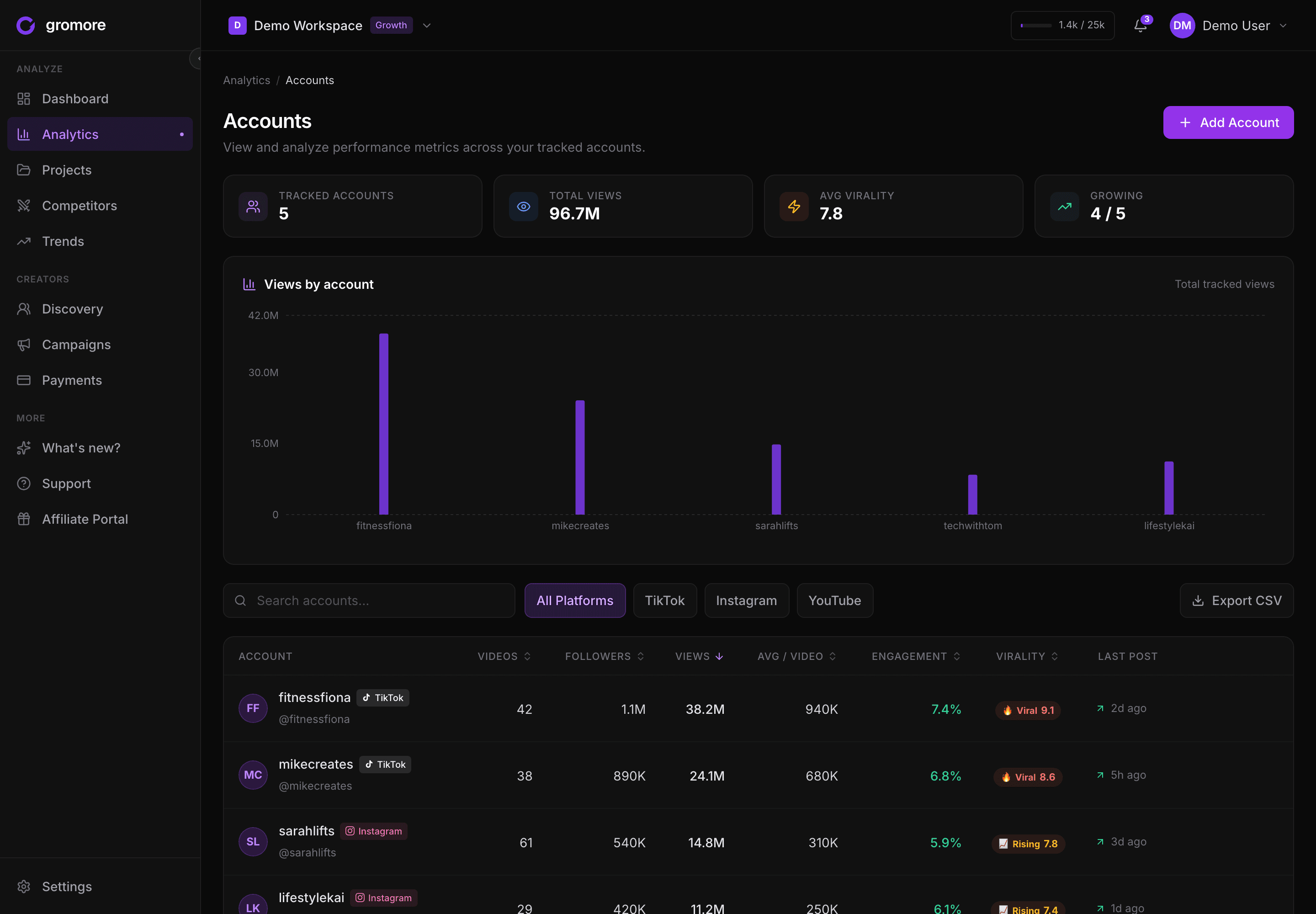
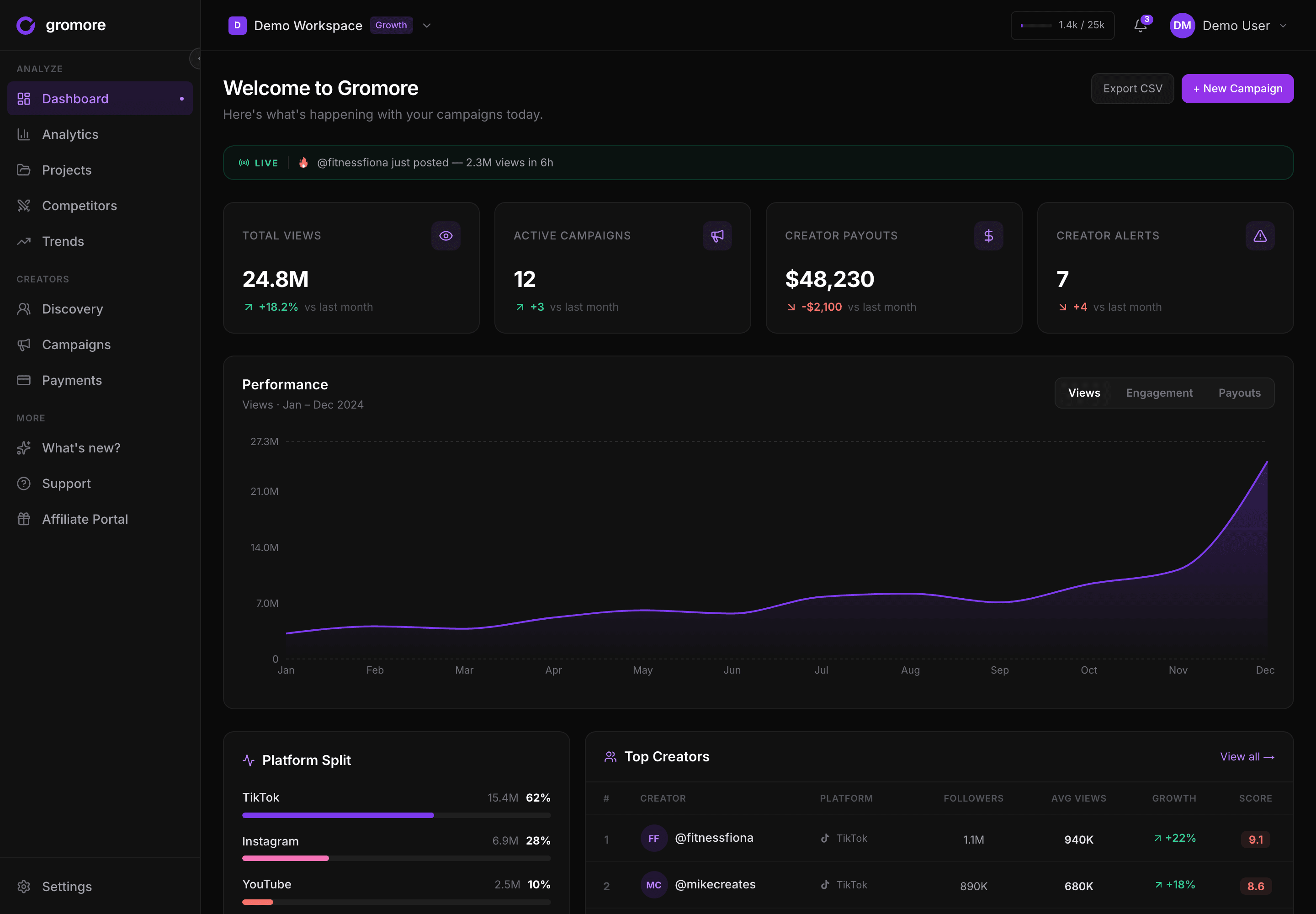
Then the content goes live — and this is where "track" enters the loop. The moment a deliverable is posted, you want it measured, not screenshotted. Add the creator's posted video or their account to your campaign, and Gromore pulls the numbers that matter across TikTok, Instagram, and YouTube — views, engagement, and how those move over the days after posting — and keeps refreshing them. That's the difference between "I think that one did well" and knowing a specific video is at 60,000 views and climbing. Because the same performance data feeds Stage 5, tracking isn't a separate reporting chore; it's the meter that decides what a performance-based payout is worth. For the full picture of which numbers to watch and why, see our guide to UGC analytics.
Stage 4: Review & approval
Now the drafts come back, and this is where feedback quietly turns into chaos. One creator's notes are in your email, another's in a WhatsApp thread, a third's in Instagram DMs, and the "final final v3" file is in a Drive folder you have to go hunting for. Multiply that by twenty creators and nobody can answer the simplest question: what's approved and what isn't?
The fix is to centralize feedback in one place and attach it to the campaign, not to your inbox. A clean approval step has a small number of clear states — submitted → in review → changes requested → approved — so at any moment you can see exactly where every deliverable stands. Feedback lives against the specific creator and the specific video, versioned, so "we already agreed to cut the intro" isn't a thing you have to relitigate from memory. When approval lives beside the campaign and the creator's record, the sign-off that ends this stage is the same record that starts the next one — no re-keying a name and a number into a payments tool.
There's real depth to getting this right at volume — batching reviews, who has sign-off authority, how to keep it fast without lowering the bar. We cover it fully in how to approve UGC at scale. For this walkthrough, the principle is enough: one system, clear states, feedback attached to the work.
Stage 5: Payout
Here's the rule that ties the whole loop together: approving a deliverable and paying for it should be one motion, not two disconnected systems. In most stacks, approval happens in one place and payment in another — so someone re-reads the contract, recalculates the bonus, retypes the amount into a banking app, and hopes they got it right. Every one of those steps is a chance to overpay, underpay, or forget someone entirely.
Doing it as one motion means the payout is calculated from the numbers you already tracked. If you agreed a base-plus-CPM-plus-milestone deal in Stage 2, the math writes itself off the performance data from Stage 3:
| Component | Rule agreed in the brief | This deliverable |
|---|---|---|
| Base fee | $150 flat per video | $150 |
| CPM bonus | $4 per 1,000 views | 60,000 views → $240 |
| Milestone bonus | +$100 if it clears 50,000 views | $100 |
| Total owed | $490 |
(Illustrative numbers, not a rate card — plug in your own from the payout-structures guide.) Instead of you doing that sum by hand for every creator, a rules engine computes it, and larger teams route it through an approval step — the person who signs off on spend isn't always the person who ran the campaign, and the approver shouldn't be able to rubber-stamp their own request.
Now the single most important thing to be clear about: Gromore calculates, tracks, and records payouts — it does not move the money. The rules engine works out what each creator is owed, routes it for approval, and writes it to an audit trail you can hand to finance. Then you pay however you already pay — bank transfer, PayPal, Wise, your agency's accounts team — and mark it paid. Gromore is the system of record for what's owed and who signed off; it never touches your bank account. That's deliberate: you keep full control of the actual transfer, and you're never handing your creator payment rails to a third party. Brief → track → payout ends with an accurate, approved, logged record of what to send — and you send it.
Where this breaks down at scale (10 creators vs. 100)
At ten creators, honestly, a spreadsheet works. You can hold the whole campaign in your head — who's briefed, who's late, who's been paid — and a shared sheet plus a folder of files gets you there. Plenty of good campaigns have run on exactly that, and dedicated influencer platforms have long served the enterprise end well. Don't over-buy for a problem you don't have yet.
The wheels come off somewhere north of a few dozen. At a hundred creators — or ten creators across ten client brands, if you're an agency — the spreadsheet becomes the bottleneck it was meant to prevent. Now you're reconciling which of a hundred drafts is approved, cross-referencing a hundred sets of view counts against a hundred slightly different payout deals, and chasing which invoices went out. The handoffs that were manageable at ten are a thousand at a hundred, and each one is a place a payment goes wrong or a deadline slips silently.
This is the scale where running the whole loop in one place stops being a nice-to-have. When the brief, the tracking, the approval, and the payout record share one system, adding the hundredth creator costs the same as adding the tenth. Agencies juggling separate rosters per client feel this hardest — which is why agency software for managing multiple client brands keeps each brand's campaigns, creators, and payouts walled off in their own workspace instead of one heroic mega-sheet.
A simple workflow checklist you can copy
Steal this. Run every creator campaign through it, start to finish:
- Brief — one core message, a hook direction, exact deliverable spec, and both a draft-submission date and a go-live date (built backwards from go-live).
- Contract — deliverables, timeline, usage rights, and the payment basis (flat, or base + CPM + milestone) locked in writing before anyone shoots.
- Onboard — one point of contact who can answer creators fast, because they're running other campaigns too.
- Track — add every posted video or account so views and engagement are measured across TikTok, Instagram, and YouTube, not screenshotted.
- Review — one system, clear states (submitted → in review → approved), feedback attached to the creator and the campaign.
- Payout — calculate what's owed from the tracked numbers, route it for approval, log it — then pay it yourself and mark it paid.
If a stage lives in a different tool than the one before it, that's the seam to close first. Every gap on this list is a place money or time leaks out.
Bottom line
Running a UGC creator campaign isn't hard because any one stage is hard — it's hard because the stages don't naturally talk to each other. A name in a research doc, a draft in an inbox, a view count in an analytics tab, and a payment in a banking app are four disconnected facts about the same creator, and every handoff between them is where control slips. Get the timeline right in the brief, keep creators unblocked, centralize approval, and calculate payouts from the numbers you already tracked — and the whole thing becomes one motion instead of four. That's the entire promise of brief → track → payout: one loop, one place, from the first message to the final record of what you owe. Just remember that last step is a record — you stay in control of the money itself.
Want to run brief → track → payout without the spreadsheet handoffs? Start a free 7-day Gromore trial — no card required.