Short answer: Good creator campaign management software runs the whole loop — brief → track → approve → payout — in one place, instead of scattering it across spreadsheets, DMs, and a separate payments tool. The features that matter most are a real payout rules engine and cross-platform tracking; the ones most tools skimp on are built-in payouts and competitor intelligence.
There's a specific moment every UGC program hits: somewhere around 15–20 creators, the spreadsheet stops working. Briefs live in Google Docs, conversations are scattered across DMs and email, approvals happen in screenshots, and payouts are a month-end reconciliation nightmare. You're spending more time administering the program than growing it.
That's the moment you need creator campaign management software — a single place to run briefs, coordination, approvals, tracking, and payouts end to end. Here's what the category should actually do, how the main tools compare, and how to choose.
What creator campaign management software actually does
At its core, it replaces the spreadsheet-plus-DMs stack with one workflow that covers the whole lifecycle:
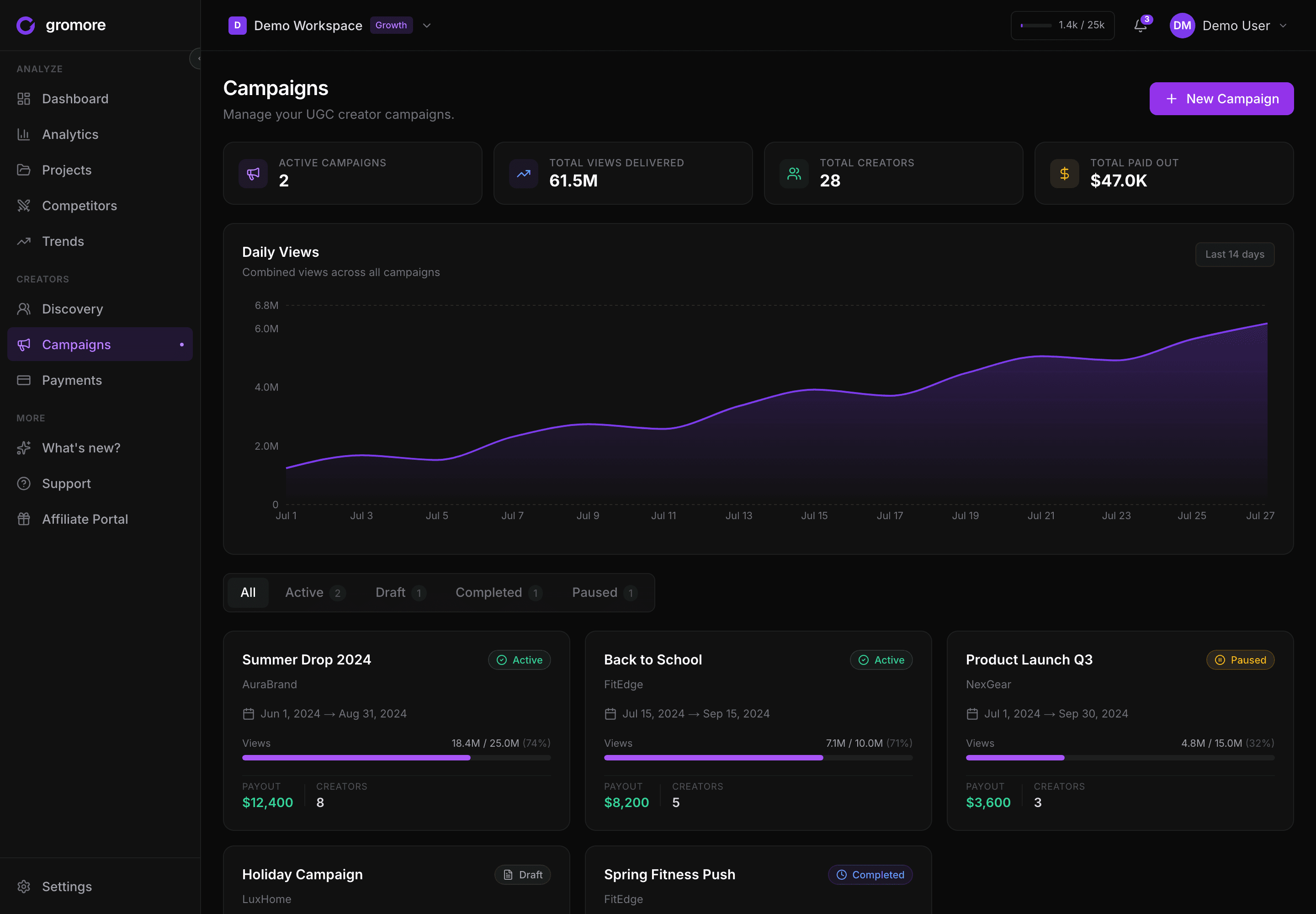
Brief → track → payout. You brief creators, track their content's performance across platforms, approve what ships, and pay based on results — without exporting data between five tools. Everything about the category below is really just doing those four things well at scale.
Walk the lifecycle and you can see where the spreadsheet leaks. You brief a batch of creators — but the brief lives in a Doc nobody re-reads. Content comes in and needs approval — but that happens over DMs, so there's no record of what was signed off. The content posts and you track it — across three platforms that each report differently, which you reconcile by hand. Then at month-end you pay — recalculating everyone's performance bonus from view counts in a sheet that's one fat-fingered cell away from paying someone triple. Campaign management software exists to make each of those four stages a step in one system instead of four disconnected chores.
The tools that matter are the ones that keep that loop in one place. The ones that don't are just dashboards with extra steps.
Signs you've outgrown the spreadsheet
You don't need dedicated software on day one — a spreadsheet is fine for your first handful of creators. You need it when these symptoms show up:
- You've lost the thread on payments. A creator posted three videos this week and you're genuinely not sure whether they were paid for last week's.
- Approvals are the bottleneck. Content sits for days because the review process is "DM me the draft and I'll get back to you."
- Reporting eats a full day. Your monthly review means copy-pasting numbers from three platforms into a deck by hand.
- Two creators got briefed on the same angle because the brief lived in someone's head instead of a system.
- You can't quickly answer "which creator is actually driving results?" without an afternoon of manual cross-referencing.
If two or more of those sound familiar, the spreadsheet is already costing you more time than the software would.
Core features to evaluate
Keep your checklist short and weighted toward the loop above:
- Brief creation & timelines. Templated briefs and deadlines so every creator gets consistent direction. Without it, each creator is briefed slightly differently and half of them miss the deadline you never formally set.
- Centralized communication. One thread per creator, tied to their content — not fifteen DM inboxes and an email folder. The scattered version is where feedback gets lost and creators go quiet.
- Content review & approval. A real creator content approval workflow with statuses and version history, not screenshots pasted into Slack and a verbal "looks good." This is usually the first thing to break at scale.
- Payout rules. Base pay, CPM, and milestone bonuses as creator payout structures the tool calculates from tracked performance, with approval routing. If payouts still mean a month-end spreadsheet, the tool solved the fun half and left you the tedious half.
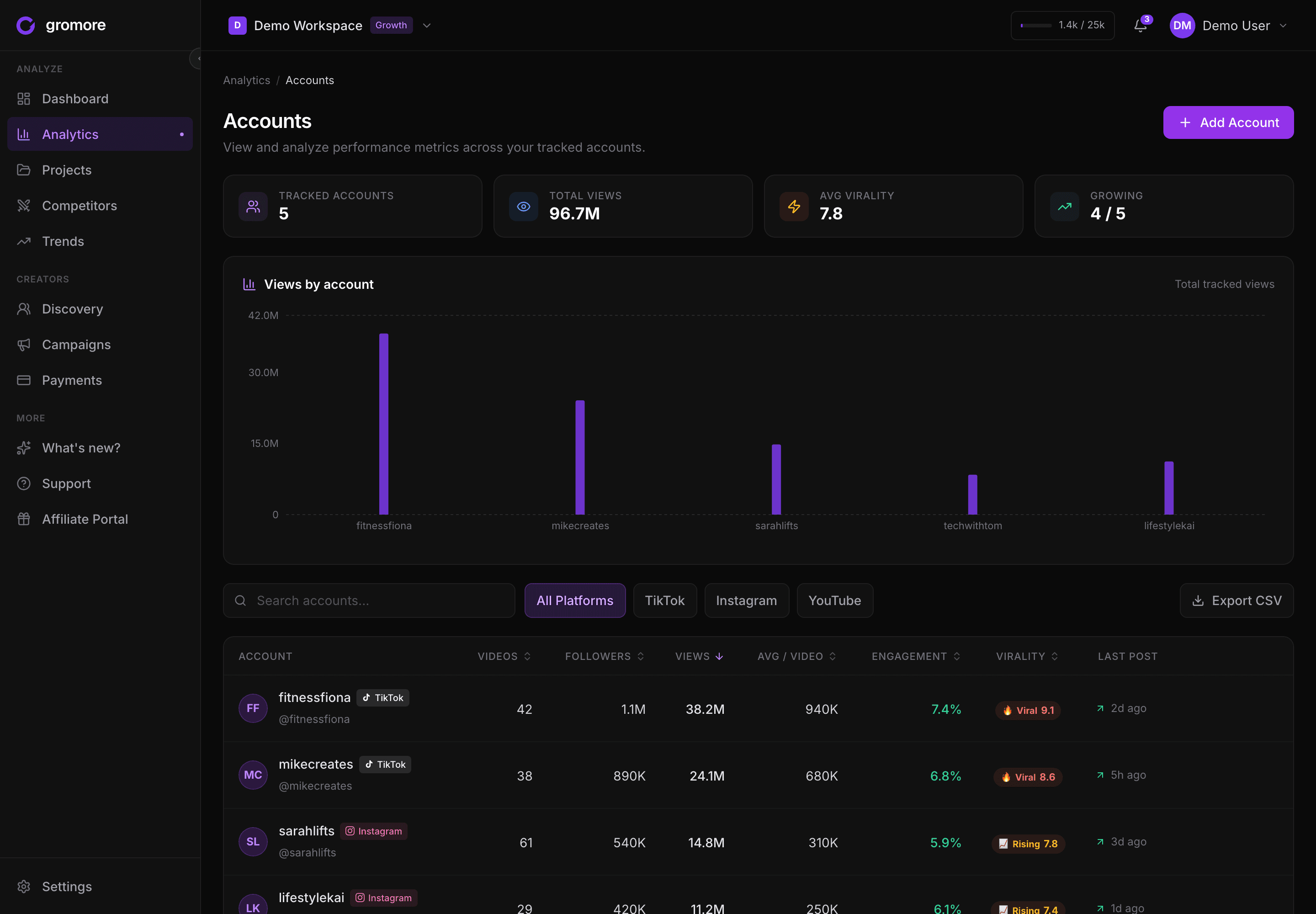
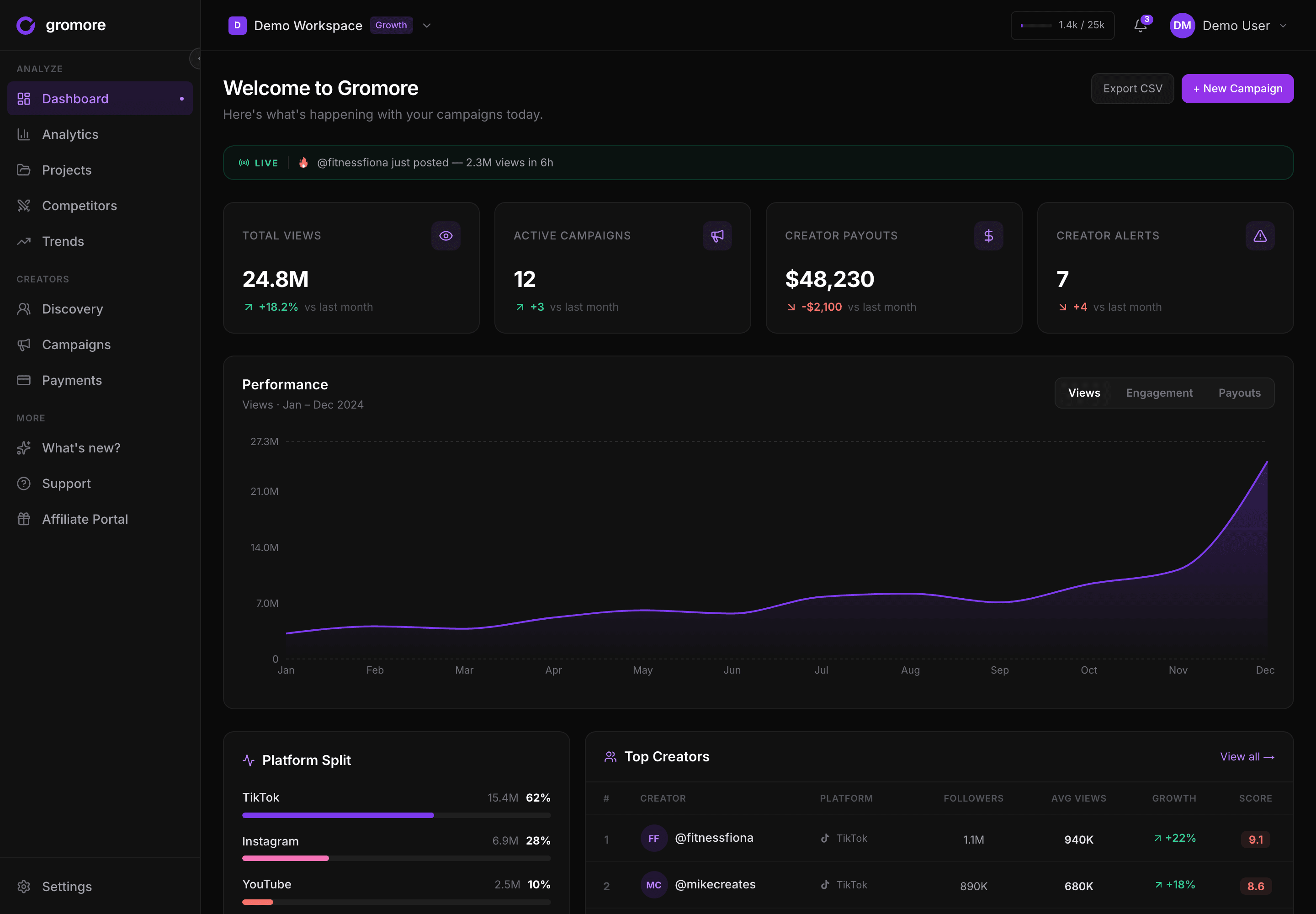
- Cross-platform tracking. TikTok, Instagram, and YouTube performance in one view, normalized — so you're not reconciling three dashboards that each count views their own way.
- Competitor creator intelligence. Bonus points if it shows which creators your competitors run, so your next roster is a proven shortlist instead of a cold search. Almost no tool in this category treats it as core — which is exactly why it's a differentiator worth weighting.
If a tool nails briefs and dashboards but makes you manage payouts in a spreadsheet, it's only solved half your problem — and it's the easy half.
Tool comparison
A quick, honest read on the main options (pricing for enterprise tools isn't public — figures below are widely-reported ranges, so verify before you commit):
| Tool | Best for | Payouts built in? | Notable |
|---|---|---|---|
| Gromore | D2C brands + agencies who want brief-to-payout in one place | Yes — base/CPM/milestone rules engine | Native competitor creator intelligence; multi-workspace; $69–$349/mo |
| CreatorIQ | Large enterprise programs | Enterprise-oriented | Deep CRM/reporting; reported enterprise pricing (tens of thousands/yr) |
| GRIN | E-commerce brands with in-house teams | Affiliate/UTM-style | Strong Shopify integration; reported low-thousands/mo |
| Dash Social | Consumer brands blending social + creator ops | Varies | Social management + creator hybrid |
| Creator.co | Brands wanting AI-assisted outreach | Varies | AI-driven briefs and negotiation |
A quick read on each:
- CreatorIQ is the enterprise standard — deep creator CRM, robust reporting, and a price to match. Right for large brands with a dedicated influencer team; overkill for most growing D2C brands.
- GRIN is strong for e-commerce brands living in Shopify, with solid product-seeding and affiliate tracking. Its payout side leans on affiliate/UTM attribution rather than a base/CPM/milestone rules engine.
- Dash Social blends social-media management with creator ops — a fit if you want both in one tool and don't need deep payout automation.
- Creator.co leans into AI for outreach and negotiation — useful when sourcing and first contact are your bottleneck rather than tracking and paying.
- Gromore points the whole tool at the brief-to-payout loop, with a base/CPM/milestone payout engine and native competitor creator intelligence, self-serve at $69–$349/mo.
The gap most of these share: payouts and competitor intelligence are afterthoughts, not core. That's the specific space Gromore is built for — the brief-to-payout loop with competitor intel baked in, at a self-serve price.
What less admin actually looks like
The real payoff isn't a feature — it's the hours you stop losing. When briefs, approvals, tracking, and payouts live in one system, the month-end scramble disappears: you're not rebuilding a payout sheet from view counts, chasing screenshots for approvals, or copy-pasting numbers into a client deck. For a program running 30+ creators, that's the difference between a full day of admin a week and an afternoon. The tool pays for itself the first time you don't reconcile payouts by hand.
How to roll it out without disrupting live campaigns
Switching mid-flight scares people, but it doesn't have to be disruptive:
- Start with one campaign, not your whole program. Pick a single active or upcoming campaign and run it entirely in the new tool while everything else stays where it is.
- Load your creators and set one payout rule. Add the campaign's creators and define a base + CPM (+ milestone) rule so payouts calculate automatically from day one.
- Move approvals in next. Once tracking and payouts feel solid, route content approvals through the tool instead of DMs.
- Then migrate the rest. With one campaign proven end to end, bring the remaining campaigns over on their natural cycle boundaries.
Run it this way and you're never betting the whole program on a new tool at once — you're proving it on one campaign, then scaling what works.
Buying checklist
Before you commit, ask:
- Does it close the whole loop — brief, track, approve, and pay — or just part of it?
- How does it handle payouts? Can you set base + CPM + milestone rules, or is it back to a spreadsheet?
- Does it track all three platforms you care about (TikTok, Instagram, YouTube)?
- What's the real price — including onboarding, contract length, and per-seat fees?
- Can it scale to how you work — one brand today, multiple client brands as an agency tomorrow?
- How fast can you be live? Minutes and self-serve, or a multi-week enterprise onboarding?
Bottom line
Creator campaign management software earns its place the moment your program outgrows the spreadsheet. Weight your decision toward the tools that keep the whole brief → track → payout loop in one place — and treat built-in payouts and competitor intelligence as core criteria, not nice-to-haves. For the bigger picture, start with our guide to UGC analytics, see how to run a campaign from brief to payout, or browse the top UGC tracking tools.
Ready to get out of the spreadsheet? Start a free 7-day Gromore trial — no card required — and run your first brief-to-payout campaign this week.