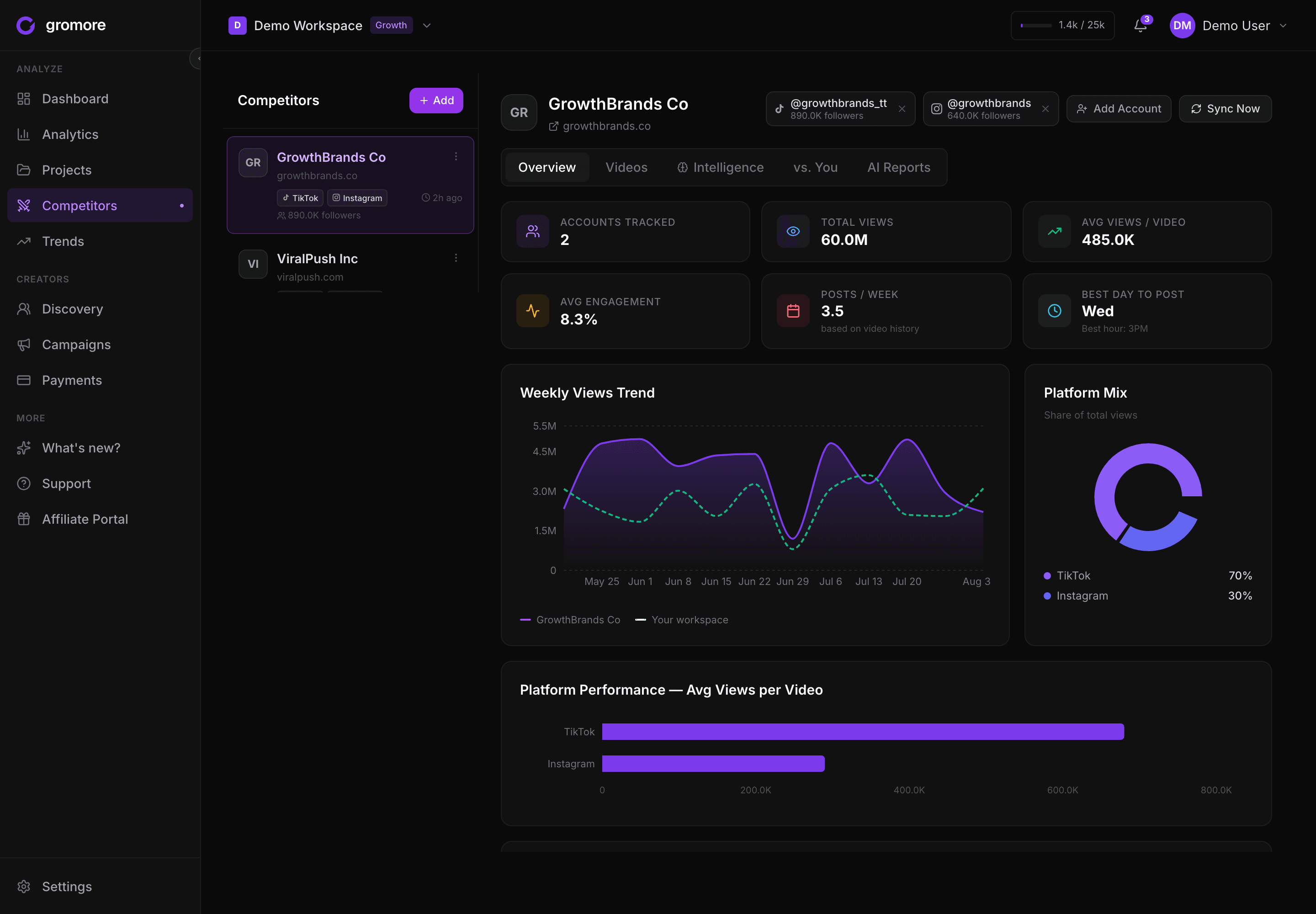
Short answer: Competitor creator intelligence is figuring out which creators a rival brand is paying to make content — on TikTok, Instagram, and YouTube — and using that as a shortlist of pre-proven partners for your own campaigns. The sharpest signal isn't who a competitor is posting with today; it's who has quietly driven results for them over the last few months.
Every D2C brand doing UGC eventually hits the same wall: finding creators who actually convert is slow, expensive, and mostly guesswork. You scroll hashtags, you test ten creators to find one that works, you burn budget learning what a competitor already knows.
Here's the shortcut most brands miss: your competitors have already run that experiment. The creators making content for the brand you're chasing are, by definition, proven in your exact niche and your exact market. Competitor creator intelligence is how you read that roster — and turn it into your own.
Why "which creators do my competitors use" is a shortcut, not a nice-to-have
Cold creator discovery is lossy. You find someone with a nice grid, you pitch, you negotiate, you brief, you wait — and half the time the content underperforms because that creator's audience never actually matched your buyer.
A competitor's active creator roster skips most of that risk:
- They're already proven in your category. A creator making skincare content that sells for a rival skincare brand has a warmed-up, relevant audience. That's the single hardest thing to verify from the outside, and a competitor has verified it for you.
- They're already comfortable with your format. Someone who cuts effective TikTok UGC for a competitor doesn't need to be taught the format. You're skipping the ramp-up.
- It's a ready-made shortlist, not cold outreach. Instead of sourcing from zero, you start from a list of names that already work.
There's a flip side that's just as valuable: conflict avoidance. If you can see a creator just wrapped an integration with a direct rival, you know to wait — or to skip them — before you spend money on a partnership that reads as a copycat or triggers an exclusivity clash.
What competitor creator intelligence actually shows you
Done properly, this is more than "here's a list of tagged accounts." The useful version tells you:
- Which creators a specific competitor is running, and on which platform — the same creator often behaves differently on TikTok vs Instagram, and you want the platform where they perform.
- The collaboration history — not just that a creator worked with a brand, but which posts performed, which formats repeated, and how long the relationship lasted. A one-off tag is noise; a creator a competitor has re-hired four times is a signal.
- Spend and budget-tier signals — who a competitor is scaling up, who they've quietly stopped using, and where they're putting new money. That tells you where a category is heating up before it's obvious.
Cross-platform matters more than it looks, too. The same creator can be a workhorse on TikTok and an afterthought on Instagram — or the reverse. Knowing where a competitor runs a given creator, not just that they do, tells you which platform that partnership actually earns on, so you don't book a TikTok star for an Instagram campaign they've never performed in.
Put together, that's not a spreadsheet of handles — it's a map of what's already working in your market, paid for by someone else.
The trap: a snapshot lies to you
This is the mistake that separates real intelligence from a vanity export, so it's worth slowing down on.
A creator's current activity is a terrible way to judge them. Look at any creator today and you might see nothing — no recent brand posts, flat engagement, quiet feed. The naive read is "inactive, skip." But UGC creators work in bursts. That same creator may have driven a competitor's best month last quarter and is simply between campaigns right now.
If you only ever see the snapshot, you'll systematically overlook the highest-value partners — the ones proven to convert, currently unbooked, and therefore available. Meanwhile you'll overrate whoever happens to be posting a lot this week, which is often just recency, not results.
A quick example. Say a rival ran a mid-sized fitness creator hard through spring — three posts, all strong sellers — then went quiet with them over summer while they tested new faces. Glance at that creator in July and they look dormant: no recent brand posts, flat feed. The snapshot says skip. But they're the single most proven partner in that competitor's entire roster, and right now nobody is paying them. History says call them first.
Follower count is the laziest version of the same error. It measures reach, not whether anyone buys. The creators who move product for D2C brands are frequently mid-sized accounts with unusually engaged, purchase-ready audiences — exactly the ones a follower-sorted list buries.
The fix is history, not a snapshot. You want to see a creator's brand-collaboration track record over time, so a quiet-but-proven partner reads as an opportunity instead of a dead end. (This is the same reason the UGC metrics that actually matter are performance-over-time, not a single day's numbers.)
How to actually use this intelligence
Reading a competitor's roster is step one. Turning it into results takes a little discipline:
- Build a shortlist, don't copy the strategy. The goal is proven creators, not a carbon copy of a competitor's campaign. Reuse the partner; bring your own hook, offer, and creative. Same creator, different story.
- Screen for conflict. Before you reach out, check whether a creator has already worked with two or three of your direct rivals this quarter. Heavy overlap means audience fatigue and a higher chance the content reads as generic category noise.
- Prioritize proven-but-available. Cross the "snapshot trap" insight with your shortlist: the best first outreach is a creator with a strong track record who isn't currently locked into a competitor campaign.
- Feed it straight into your workflow. Intelligence that lives in a research doc dies in a research doc. The point is to move a name from discovery → shortlist → brief → tracked → paid, without re-keying data into three different tools.
And none of this works as a one-off. Competitor rosters shift every few weeks — a brand quietly onboards three new creators, drops two, doubles down on one. Treat this as a standing feed you scan before every campaign, not a report you pull once and forget.
That last point is where most "competitor analysis" workflows fall apart — which brings us to the tools.
Tools that offer this today (an honest look)
Be clear-eyed here: most tools that rank for "competitor analysis" are adjacent to what you actually need, not built for it.
- Broad social-listening and competitive-analytics suites (think Sprout Social, Socialinsider, Metricool) benchmark competitors at the account level — follower growth, posting cadence, engagement. Creator relationships are, at best, one bullet buried in a much wider dashboard.
- Creator and sponsorship databases (HypeAuditor, Phlanx-style tools) get closer — they can surface creator–brand associations — but they sit outside your campaign workflow. You find a creator, then you leave the tool to brief and pay them somewhere else.
The gap every one of these leaves open is the same: none of them connect "I found a creator my competitor uses" to "I've briefed and paid that creator." You still export a list, re-import it into a campaign tracker, and manage payouts in a spreadsheet. The intelligence and the action live in different places.
How Gromore surfaces this
Gromore was built to close exactly that gap, which is why competitor creator intelligence is native to the platform rather than a bolted-on report.
Add a competitor brand, and Gromore shows you which creators are running that brand's content across TikTok, Instagram, and YouTube — without the competitor knowing. Instead of a raw data dump, its AI turns that activity into plain-English insight: new creators a rival just started working with, and spend signals showing where they're scaling up or pulling back.
In practice, your first session looks less like research and more like a to-do list: here are the creators your top competitor started running this month, here's the one they've re-hired most often, here's where their budget is moving. You leave with names to brief — not a dashboard to decode.
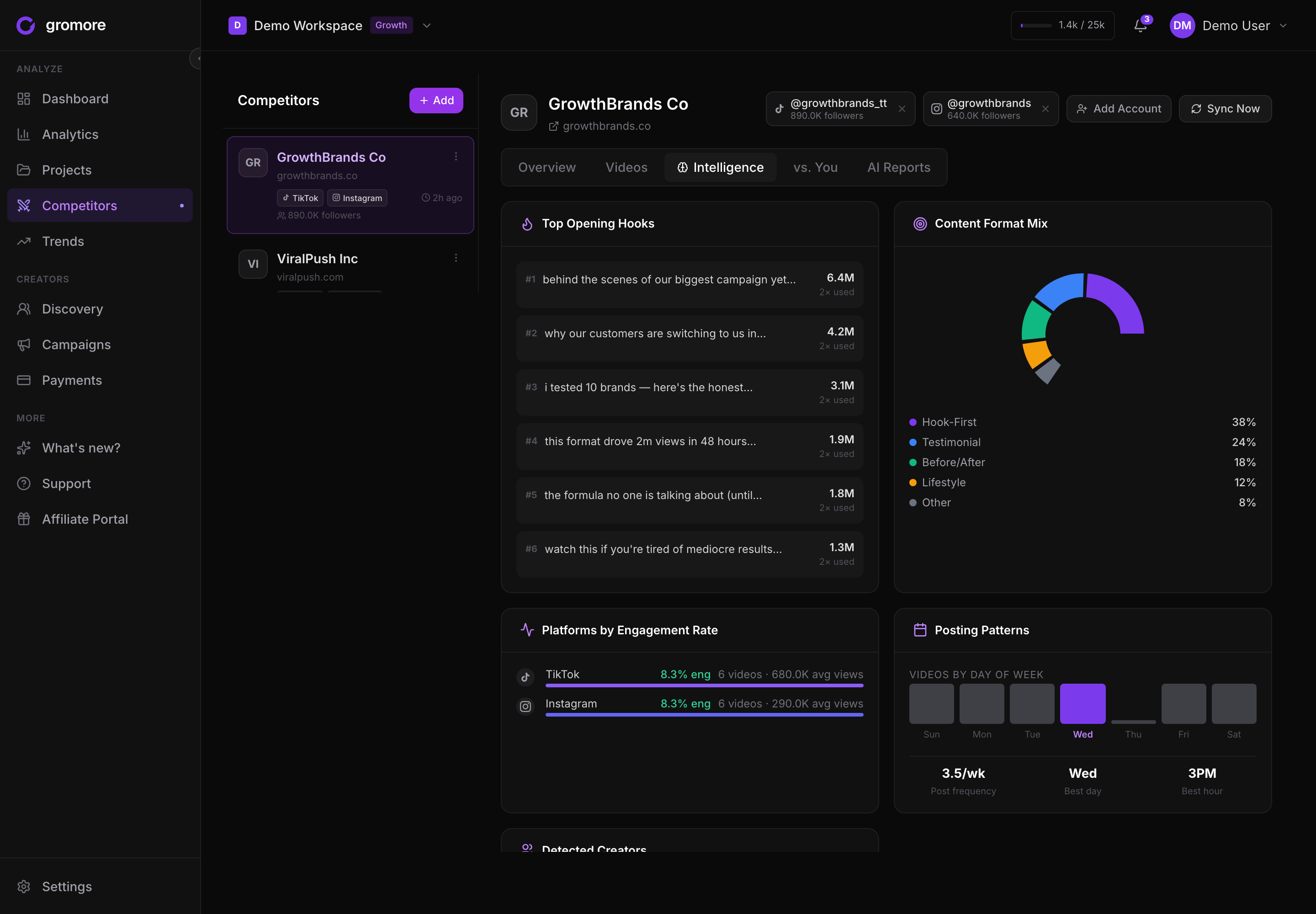 Beyond the roster, the Intelligence view surfaces what's actually working for a competitor — their highest-performing hooks and content-format mix — so you can brief your own creators against proven angles.
The difference is what happens next. Because this lives in the same platform where you run your own campaigns and creator payouts, a promising name goes straight from competitor discovery → your shortlist → a campaign brief → performance tracking → a creator payout — no exporting, no re-importing, no spreadsheet handoff. The intelligence and the action finally live in one place.
It also pairs with the rest of the picture: TikTok creator analytics and Instagram UGC tracking on the creators you find, plus early viral-trend detection so you spot a competitor's rising format before it's obvious. For the full framework, see our guide to UGC analytics.
Bottom line
Your competitors have already spent the money to find creators who convert in your market. Competitor creator intelligence is how you read that work — as long as you judge creators by their track record over time, not by whatever they happened to post this week, and as long as the tool you use connects discovery directly to actually running and paying for the campaign.
That end-to-end connection — competitor discovery to payout, in one platform — is the whole point.
Want to see which creators your competitors are running? Start a free 7-day Gromore trial — no card required — and add your first competitor in under five minutes.