Short answer: TikTok trends move fast — a format can peak in a day or two, while many tools only report on a daily or weekly batch. But spotting a trend early is only half the game. The brands that win are the ones that can turn a spotted trend into a briefed creator before the window closes — which is a workflow problem as much as a discovery one.
Every brand has felt it: you see a format blowing up, you scramble to make your own version, and by the time it's briefed, approved, and posted, the trend has moved on. TikTok's speed is the whole appeal — and the whole problem. This is how to think about trend discovery as a brand: how to detect early-viral content, and, more importantly, how to actually act on it in time.
The speed problem: trends move faster than most tooling
The core tension is timing. A TikTok format can go from emerging to saturated in a day or two, while a lot of "trend" tooling reports on a daily or weekly cadence. By the time a batch report surfaces a trend, the easy window — where you can ride it without looking late — is often already closing.
That has two implications. First, for detection, you want the freshest signal you can get. Second — and this is the part most brands underweight — detection speed is wasted if your briefing and approval process takes a week. A real-time trend feed feeding a slow workflow just tells you, faster, about trends you'll still miss.
What early-viral detection actually looks for
Raw view count is a lagging, misleading signal — by the time something has tens of millions of views, it's not early anymore. The better signal is performance relative to a baseline: a video doing dramatically more than its creator's or category's norm — some tools flag content running, say, 12× above baseline — is a far earlier indicator than a big absolute number.
Make it concrete. A creator whose videos average 40,000 views suddenly posts one doing 500,000 in a few hours — that ~12× jump is a signal before the number looks huge. One outlier isn't a trend, though; the real read is when the format or hook behind it starts repeating across multiple creators. That shift — from a single outlier to a repeating pattern — is what you're actually hunting for.
It's also worth watching sounds, not just formats. On TikTok, a climbing audio is often the earliest signal of all — creators adopt a sound before the visual format around it fully forms. Spot a sound rising and have a creator ready to use it in a brand-relevant way, and you're early by design. Native tools surface trending audio directly, which is one more reason to start there.
Native TikTok tools (start here, they're free)
Before any third-party tool, use what TikTok gives you:
- TikTok Creative Center — Trend Discovery. Breaks down trending hashtags, songs, and creators by region, industry, and demographic. It's the closest thing to an official trend source.
- The Explore / search surface. Category browsing (Fashion, Beauty, Food & Drink, etc.) and search give you a fast, free read on what's surfacing in your niche right now.
Also watch hashtags and challenges here — a format or branded hashtag climbing in your niche is a cheap, early read on where attention is moving, and native search shows you velocity for free. For many brands, native tools plus a sharp eye are genuinely enough to detect what's rising. The gap, almost always, is acting on it fast enough — which is where third-party tools and (mostly) your own workflow come in.
Third-party trend & viral discovery tools
When you want more systematic outlier detection, third-party tools help:
- Virlo — built around above-baseline (outlier) flagging; the closest dedicated tool for early-viral detection on this exact use case.
- Exolyt / Pentos — combine competitor tracking, trend data, and audio/hashtag discovery in one analytics view.
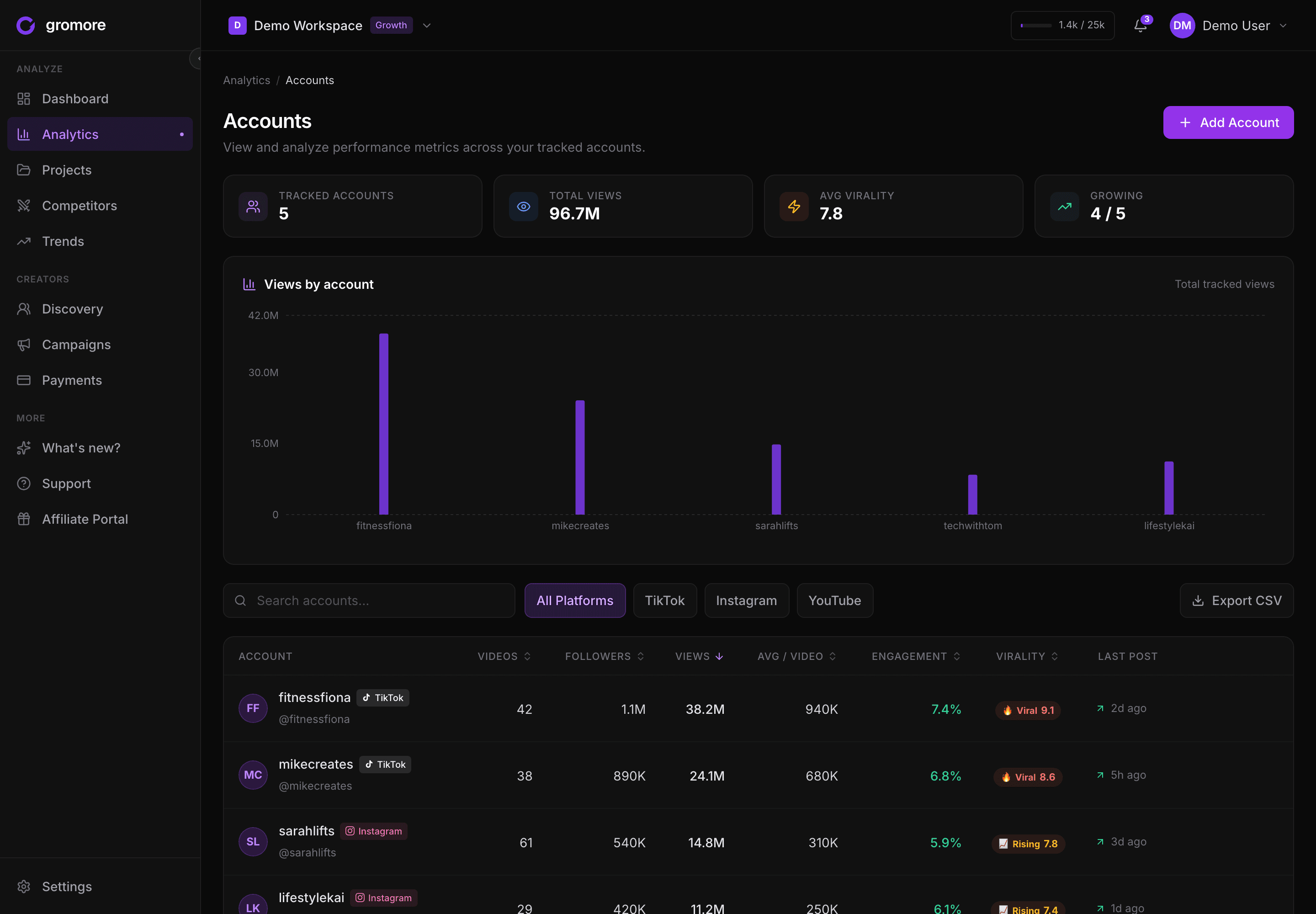
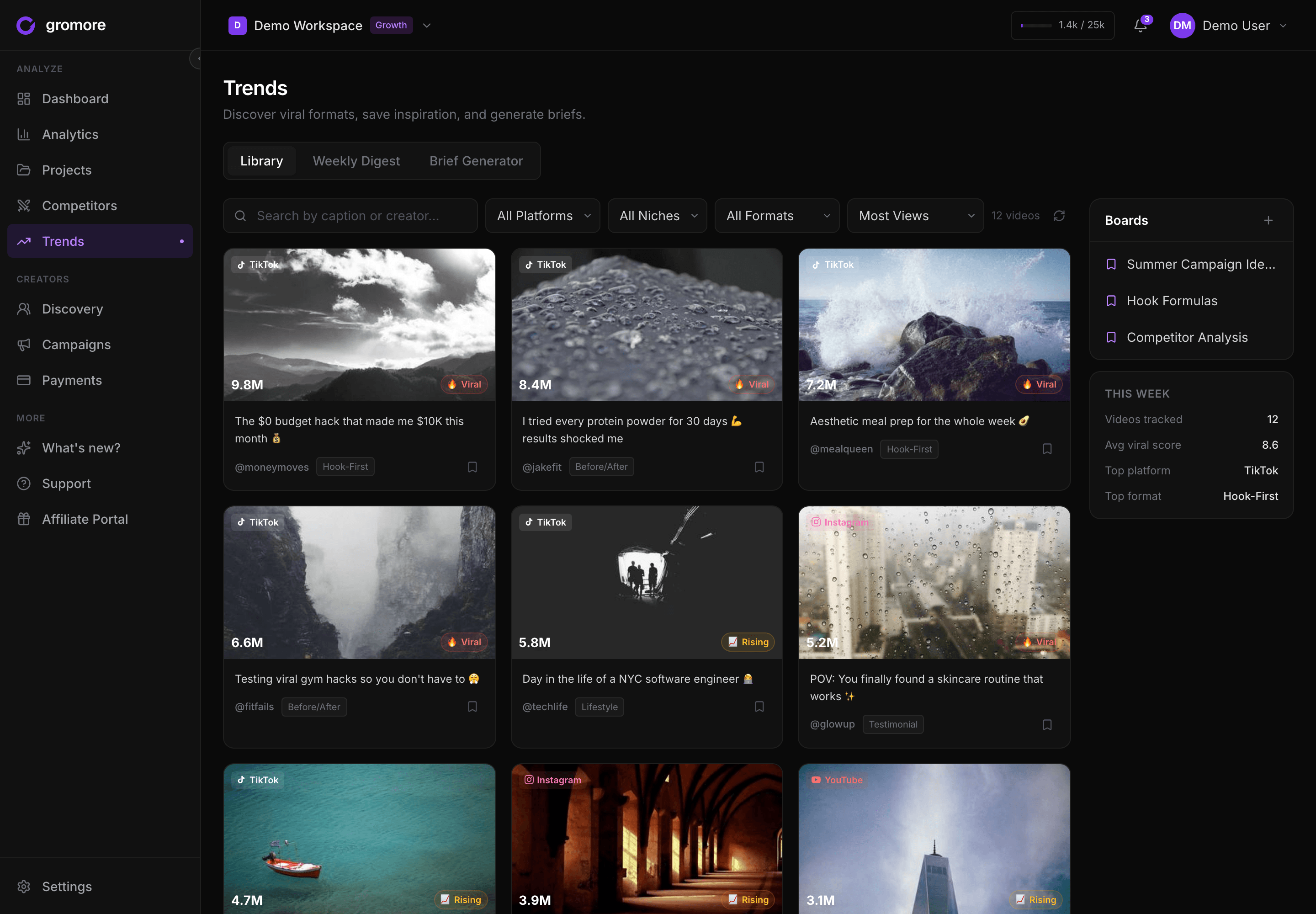
- Gromore — a viral/trend content library that surfaces trending and rising videos by platform, niche, and format, with a Brief Generator that turns a spotted trend into a creator brief. Its edge isn't out-detecting a real-time tool (Gromore's discovery refreshes periodically, not by the second) — it's that discovery sits in the same platform as your creator roster and campaigns, so a trend becomes a briefed creator without leaving the tool.
Be honest with yourself about which job you're solving. For bleeding-edge detection, pair TikTok's native tools with an outlier tool like Virlo. For acting on what you find, you want it wired into your roster.
From trend-spotted to content-live: closing the real gap
Here's the uncomfortable truth for most brands: your bottleneck isn't discovery — it's everything after it. If you spot a trend on Monday and your process is "find a creator → negotiate → brief → wait for draft → chase approvals," you're posting the following week, and the trend is cold.
The fix is having the pieces ready before the trend hits:
- A roster you can brief instantly — creators already in your system, so "who makes this?" is a filter, not a search.
- A brief you can generate fast — a repeatable template, not a blank doc.
- An approval process that takes hours, not days.
Notice that none of those three are discovery features — they're workflow. That's the reframe most brands miss: buying a faster trend detector while keeping a slow briefing process is optimizing the wrong half. Fix the workflow first, and even native, free trend tools become enough to act on.
This is exactly why trend discovery is most valuable when it lives next to your competitor creator intelligence and your creator campaign management — spot the format, pick a proven creator, brief them, and track it, all in one place. Discovery in isolation just tells you what you missed, faster.
A practical multi-tool approach
You don't need one perfect tool — you need a fast pipeline:
- Detect with TikTok's native Creative Center + an outlier tool (Virlo-style) for above-baseline flags.
- Validate that it's a repeating format across creators, not a one-off — check whether the hook is spreading.
- Act by pulling a proven creator from your roster and briefing them the same day — the step that actually determines whether you catch the wave.
Detection gets the headlines; the third step is where brands actually win or lose.
How often should you check? For most brands, a quick daily scan of native trends in your niche plus one deeper weekly review is plenty — you're not trying to catch every trend, you're trying to catch the two or three a month that genuinely fit your product. Chasing everything is how brands end up posting off-brand content that ages badly. When speed and fit conflict, fit wins. And when a trend does fit, the brands that come out ahead aren't the ones who spotted it first — they're the ones who had a creator briefed and filming while everyone else was still forwarding the link around Slack.
Bottom line
TikTok trends move faster than most tooling reports, so spotting one early matters — use native tools plus an outlier-detection tool for the freshest signal. But detection is only half the job: the brands that consistently ride trends are the ones whose briefing and approval process is fast enough to act, with a roster ready to go. Optimize for speed-to-brief, not just speed-to-spot. For the full framework, start with the guide to UGC analytics.
Want trend discovery wired straight into your creator roster and campaigns? Start a free 7-day Gromore trial — no card required.