7 UGC Metrics Every D2C Brand Should Track Beyond Vanity Numbers
The most important UGC metrics for D2C brands go far beyond views and likes. Track earned media value (EMV), content velocity, creator reuse rate, save-to-like ratio, UGC conversion rate, cost per quality content, and audience sentiment score to connect creator campaigns to actual revenue and long-term brand growth.
Here's a stat that should make every D2C marketer uncomfortable: 92% of consumers trust user-generated content more than traditional advertising, according to Nielsen. Yet most brands still measure UGC the same way they measure banner ads — with impressions, views, and likes.
Those numbers aren't useless. They tell you whether content got seen. But they tell you almost nothing about whether that content drove someone to buy your product, whether it's worth reusing in paid ads, or whether the creator who made it is worth hiring again.
If you're running creator campaigns for a D2C brand — or managing them on behalf of clients — you need UGC performance metrics that tie directly to business outcomes. Vanity metrics fill dashboards. The seven metrics below fill pipelines.
Let's break each one down: what it is, why it matters, and exactly how to capture it.
1. Earned Media Value (EMV)
What it is
Earned media value assigns a dollar amount to organic engagement and impressions generated by UGC, based on what you would have paid for equivalent reach through advertising. Think of it as the "what would this have cost me?" metric.
Why it matters for D2C brands
EMV is the single fastest way to justify UGC spend to a CFO. When you can say "We paid 12 creators $15,000 total and generated $87,000 in earned media value," the ROI conversation becomes very simple.
According to Influencer Marketing Hub's 2024 benchmark report, brands earn an average of $5.20 in EMV for every $1 spent on influencer marketing. But that average hides enormous variance — some campaigns return $0.50 and others return $20+. Tracking EMV per campaign and per creator is how you find the $20 creators.
How to capture it
EMV = (impressions × CPM benchmark / 1,000) + (engagements × CPE benchmark). You'll need platform-specific CPM and CPE benchmarks for your industry. Tools like Gromore calculate EMV automatically across TikTok, Instagram, YouTube, and Facebook, so you don't have to maintain your own benchmark spreadsheets.
2. Content Velocity
What it is
Content velocity measures the volume of UGC assets produced per campaign, per time period, or per creator. It's typically expressed as "pieces of usable content per week" or "per campaign cycle."
Why it matters for D2C brands
D2C brands need a constant stream of fresh creative for paid social. Meta's own research shows that ad fatigue sets in after roughly 4 exposures to the same creative, which means you need new content constantly. Content velocity tells you whether your creator program is producing enough raw material to keep your ad accounts fed.
It also flags operational bottlenecks. If you briefed 20 creators and only 8 delivered content in the expected window, your content velocity is telling you something about your onboarding process, your brief quality, or your creator selection.
How to capture it
Track total deliverables received divided by campaign duration. Break it down by creator to identify your most prolific (and reliable) partners. A good creator campaign analytics platform will track this automatically alongside quality signals, so you're not just measuring volume in a vacuum.
3. Creator Reuse Rate
What it is
Creator reuse rate is the percentage of creators from a campaign that you re-engage for subsequent campaigns. A high reuse rate signals that you've found reliable, high-performing creators. A low rate means you're constantly starting from scratch.
Why it matters for D2C brands
Recruiting new creators is expensive and slow. Industry data suggests that onboarding a new creator — from outreach through first deliverable — costs brands roughly 3–5× more in time and coordination than re-engaging a proven creator. Reuse rate quantifies how well you're building a sustainable creator roster rather than treating every campaign as a one-off.
It also correlates with content quality. Creators who understand your brand, have shot your products before, and know your audience tend to produce better-performing content the second and third time around.
How to capture it
Divide the number of creators used in campaign N who also appeared in campaign N-1 (or any prior campaign) by total creators in campaign N. Track the trend quarterly. If it's declining, investigate whether the issue is creator satisfaction, payment timing, or brief clarity.
4. Save-to-Like Ratio
What it is
The save-to-like ratio compares the number of saves (or bookmarks) a piece of UGC receives to its total likes. A like is passive. A save is someone saying "I want to come back to this" — and on platforms like Instagram and TikTok, it's a much stronger intent signal.
Why it matters for D2C brands
Saves indicate purchase consideration. When someone bookmarks a product review or a styling video, they're often one step away from buying. Content with a high save-to-like ratio is exactly the content you should be repurposing as a paid ad or featuring on your product pages.
Instagram's algorithm also weights saves more heavily than likes when deciding what to distribute via Explore and Reels. So content with high saves tends to get more organic reach — a compounding advantage.
How to capture it
Pull saves and likes per post from platform analytics or your UGC tracking tool. Calculate saves ÷ likes. Benchmark: a save-to-like ratio above 0.07 (7%) is considered strong for most consumer product categories. Anything above 0.12 is exceptional and worth immediately flagging for paid amplification.
5. UGC Conversion Rate
What it is
UGC conversion rate measures the percentage of users who take a desired action — purchase, sign-up, add-to-cart — after engaging with a piece of user-generated content. This is the metric that directly connects UGC to your bottom line.
Why it matters for D2C brands
This is the metric your CEO actually cares about. According to a 2023 Bazaarvoice study, shoppers who interact with UGC on product pages convert at a 161% higher rate than those who don't. But that's a broad average. Your UGC conversion rate tells you which specific creators and content types are driving your specific customers to buy.
Without this metric, you're guessing which content is "working." With it, you can allocate budgets to the creators and formats that generate actual revenue.
How to capture it
Use UTM parameters, unique discount codes, or affiliate tracking links assigned to each creator. Measure conversions attributed to each piece of content. For on-site UGC (like reviews or photo galleries on product pages), use A/B testing or engagement-to-purchase path analysis in your analytics platform.
6. Cost Per Quality Content (CPQC)
What it is
CPQC measures how much you spend to get one piece of content that meets your quality bar — content that's actually usable in ads, on your website, or across owned channels. It's different from cost-per-content because it only counts assets that pass your internal review.
Why it matters for D2C brands
Paying 50 creators $200 each doesn't cost $10,000 if only 30 of them deliver usable content. It costs $333 per quality asset, not $200. CPQC gives you the real unit economics of your creator program and helps you compare it honestly against alternatives like studio shoots or stock content licensing.
It also forces a useful internal conversation: what counts as "quality"? Teams that define this clearly — lighting standards, brand compliance, minimum resolution, hook structure — tend to get better content from creators because they write better briefs.
How to capture it
Total campaign spend (creator fees + platform costs + internal time) ÷ number of assets that passed quality review. Track CPQC per campaign and per creator tier. You'll often find that mid-tier creators ($150–$400 per deliverable) offer the best CPQC, while nano-influencers have lower per-unit cost but higher rejection rates.
7. Audience Sentiment Score
What it is
Audience sentiment score evaluates the emotional tone of comments, replies, and reactions to UGC. It goes beyond counting engagement to understand whether that engagement is positive, negative, or neutral.
Why it matters for D2C brands
A video with 500 comments sounds great — until you read the comments and discover half of them are criticizing the product or calling the sponsorship inauthentic. Sentiment analysis catches what raw engagement numbers miss.
It's particularly important for influencer marketing KPIs because audience trust is the whole point. If a creator's audience reacts negatively to branded content, that partnership is actively hurting your brand — regardless of the view count.
How to capture it
AI-powered sentiment analysis tools scan comment sections and classify responses as positive, neutral, or negative. Some platforms also detect sarcasm, spam, and bot activity, giving you a cleaner read. Gromore's AI-powered analytics includes sentiment tracking across platforms, so you can spot problematic reactions before they snowball.
Putting These UGC Metrics to Work
Tracking seven metrics sounds like a lot — until you realise most of them can be captured automatically with the right tooling. The real challenge isn't measurement. It's acting on what the data tells you.
Here's a practical framework for using these UGC performance metrics together:
- Campaign planning: Use content velocity and CPQC from past campaigns to set realistic budgets and creator counts.
- Mid-campaign monitoring: Watch save-to-like ratio and sentiment score in real time to flag top-performing and underperforming content.
- Post-campaign analysis: Calculate EMV, UGC conversion rate, and creator reuse rate to decide who to re-engage and what to amplify.
- Quarterly reviews: Compare all seven metrics quarter-over-quarter to measure whether your creator program is genuinely improving.
If you're managing this across multiple brands — as UGC agencies increasingly do — the complexity multiplies. That's where a dedicated UGC analytics platform pays for itself. Spreadsheets work for one brand with five creators. They break at three brands with fifty creators each.
Why Most Brands Get Stuck on Vanity Metrics
It's worth asking: if these metrics are so important, why aren't more brands tracking them?
Three reasons:
- Platform dashboards default to vanity metrics. TikTok and Instagram show you views, likes, and follower counts on the surface. The deeper signals are buried or require API access.
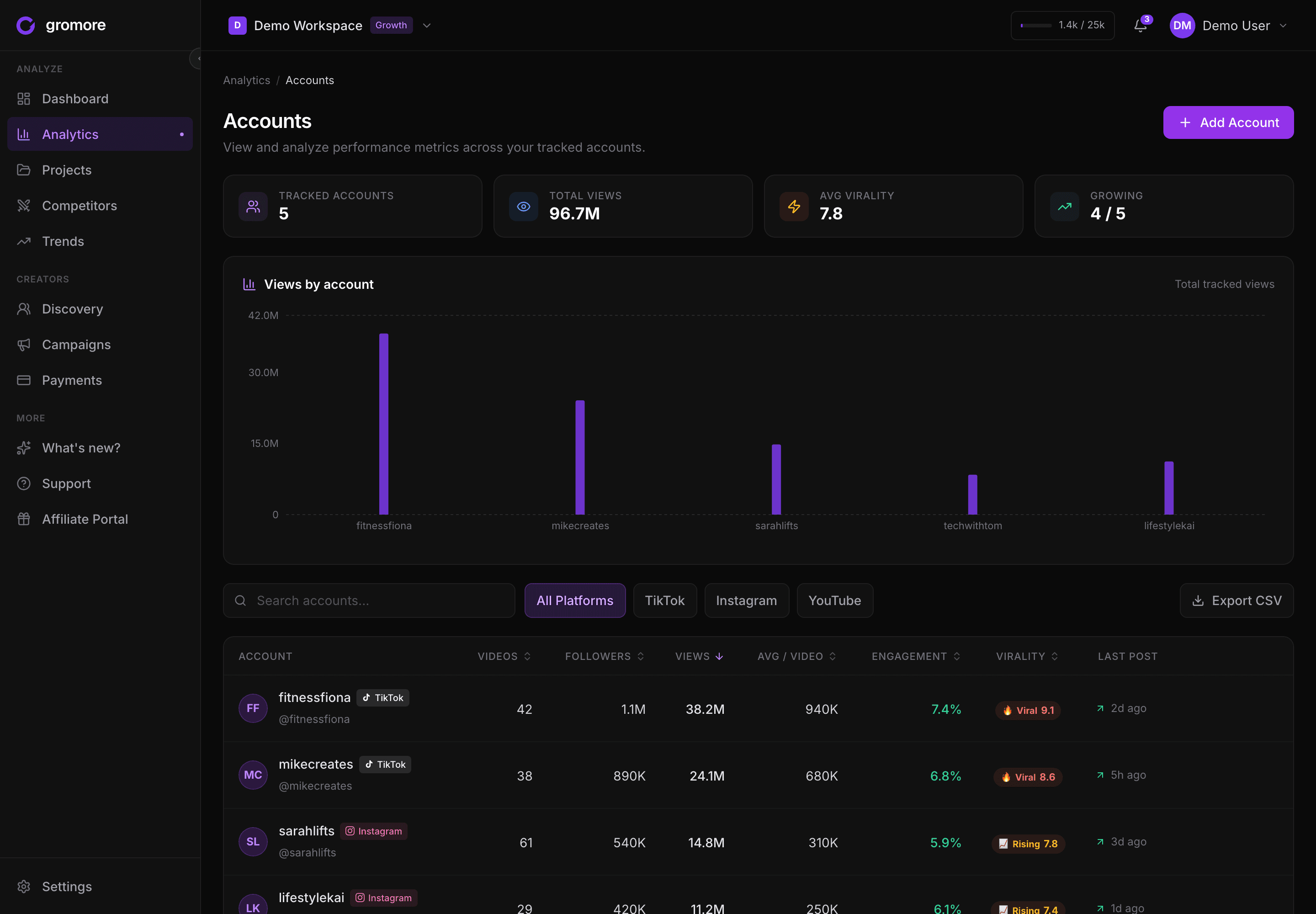
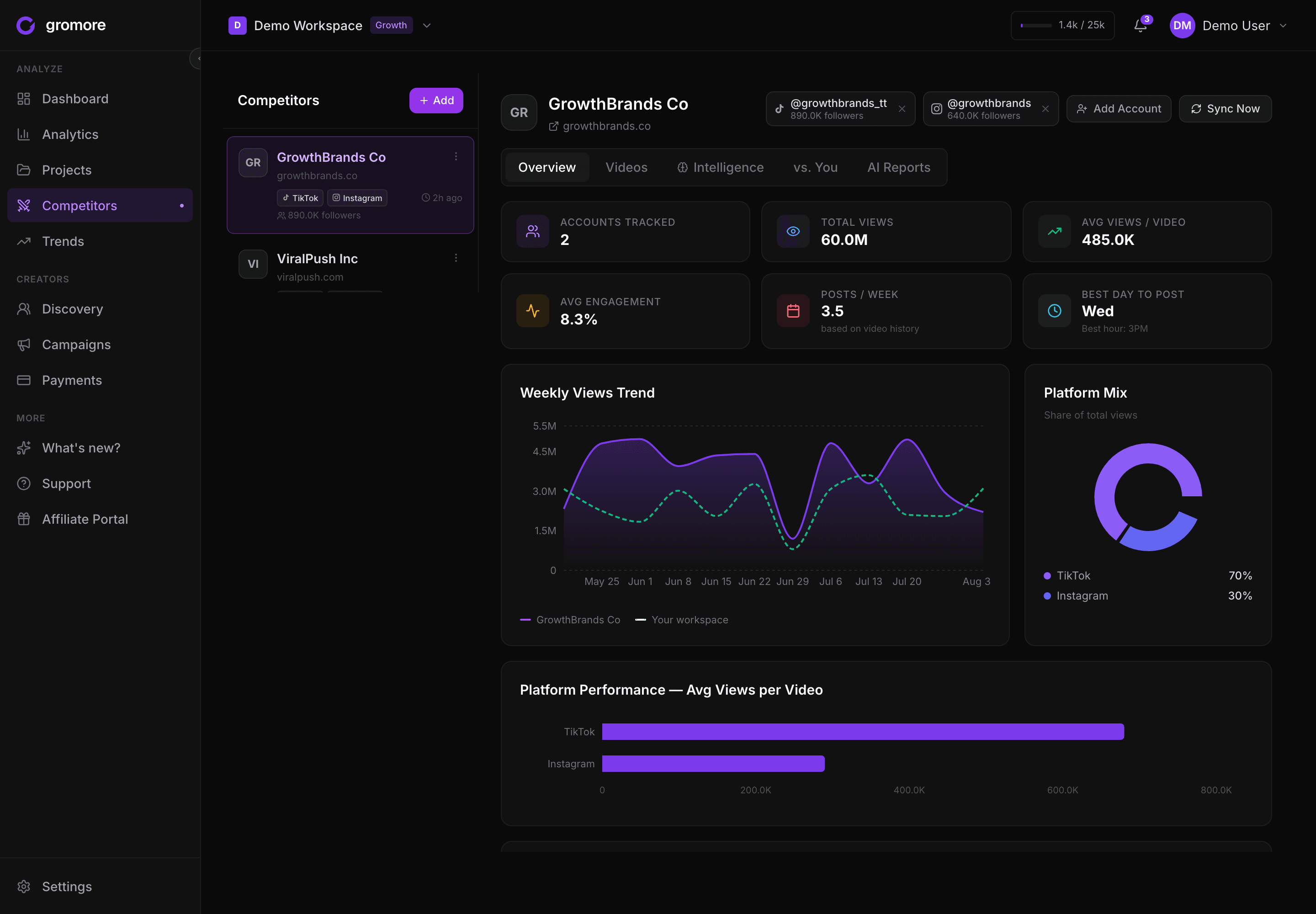
- Cross-platform tracking is hard. A creator might post on TikTok, Instagram Reels, and YouTube Shorts. Rolling up performance across all three into a single campaign view requires tooling that most brands don't build in-house.
- Attribution is messy. Connecting a TikTok video to a Shopify purchase requires tracking infrastructure — UTMs, pixel integration, or unique codes — that takes deliberate setup.
None of these are unsolvable problems. They're just problems that require intentional investment in your measurement stack. And the brands that make that investment early are the ones that scale creator programs from "nice experiment" to "core growth channel."
Gromore was built to solve exactly this problem — giving D2C brands and agencies an affordable platform that tracks all seven of these metrics across TikTok, Instagram, YouTube, and Facebook without the enterprise price tag.
Conclusion: Measure What Moves Revenue
Views and likes will always have a place in your reporting. They're fast, intuitive, and easy to benchmark. But if they're the only UGC metrics in your dashboard, you're flying blind on the questions that actually matter: Is this content driving purchases? Is this creator worth re-hiring? Is our program getting more efficient over time?
The seven metrics outlined above — EMV, content velocity, creator reuse rate, save-to-like ratio, UGC conversion rate, CPQC, and audience sentiment — give you a complete picture of creator campaign performance. Together, they turn UGC from a brand awareness tactic into a measurable growth engine.
Ready to track the UGC metrics that actually matter? Start your free Gromore account and connect creator performance to revenue from day one. Gromore tracks all seven metrics across every major platform — no spreadsheets, no guesswork. → Sign up at Gromore.io/signup
What are the most important UGC metrics to track?
The most important UGC metrics go beyond views and likes. D2C brands should track earned media value (EMV), content velocity, creator reuse rate, save-to-like ratio, UGC conversion rate, cost per quality content (CPQC), and audience sentiment score. These metrics connect creator content directly to revenue and operational efficiency.
How do you calculate earned media value for UGC?
Earned media value is calculated by multiplying impressions by your industry's CPM benchmark (divided by 1,000) and adding engagements multiplied by your CPE benchmark. The formula is: EMV = (impressions × CPM / 1,000) + (engagements × CPE). Industry averages show brands earn roughly $5.20 in EMV per $1 spent on influencer marketing.
What is a good save-to-like ratio on Instagram or TikTok?
A save-to-like ratio above 0.07 (7%) is considered strong for most consumer product categories. A ratio above 0.12 (12%) is exceptional and indicates the content has high purchase-consideration value — making it an ideal candidate for paid amplification or repurposing on product pages.
How does UGC conversion rate differ from regular conversion rate?
UGC conversion rate specifically measures the percentage of users who complete a desired action (purchase, sign-up, add-to-cart) after engaging with user-generated content. Research from Bazaarvoice shows shoppers who interact with UGC convert at a 161% higher rate than those who don't, making it a critical metric for attributing revenue to creator campaigns.
What is cost per quality content (CPQC) and how do you measure it?
CPQC measures the total cost to produce one piece of content that meets your usability and quality standards. Calculate it by dividing total campaign spend (creator fees + platform costs + internal time) by the number of assets that passed your quality review. It gives you the true unit economics of your creator program — not just the sticker price per creator.
Why is creator reuse rate important for D2C brands?
Creator reuse rate shows what percentage of creators you re-engage across multiple campaigns. A high reuse rate reduces onboarding costs (re-engaging a proven creator costs roughly 3–5× less in time and coordination than recruiting a new one) and typically correlates with higher content quality, since returning creators already understand your brand and audience.
What tools can track UGC metrics across multiple platforms?
Gromore is a UGC analytics platform that tracks all major UGC performance metrics — including EMV, content velocity, sentiment, and conversion signals — across TikTok, Instagram, YouTube, and Facebook in a single dashboard. It's designed for D2C brands and agencies that need cross-platform creator campaign analytics without enterprise pricing.