Short answer: UGC creators typically charge $50–$150/video at entry level, $150–$350 experienced, and $350–$500+ premium — with roughly 80% of rates landing under $500/video. Beyond the sticker price, how you structure pay (per-video, retainer, or a base-plus-performance hybrid) matters as much as the number.
Most articles about UGC rates are written for creators — "how much can I charge?" This one is written for brands: how much you should budget, how to structure it, and how to keep costs predictable as you scale. Let's start with the numbers, because that's what you came for.
UGC creator rates by experience tier
Here's roughly what UGC creators charge per video in 2026 (rates vary by niche, platform, and deliverables — treat these as anchors, not gospel):
| Tier | Typical rate / video | Who they are |
|---|---|---|
| Entry-level | $50–$150 | Newer creators building a portfolio; great for volume testing |
| Experienced | $150–$350 | Proven UGC creators with a track record of converting content |
| Premium | $350–$500+ | Top creators, strong niche authority, or high production value |
The useful reality: about 80% of UGC costs cluster under $500/video. If someone quotes you four figures for a single UGC clip, they're either a genuine premium specialist or mispriced — either way, set that expectation with your team early so a few high quotes don't distort your budget.
What pushes a rate up: extra hooks or variations, longer formats, usage-rights extensions (especially paid-ad whitelisting), exclusivity, and organic posting from the creator's own account (which adds their audience on top of the raw footage). Be clear about which of these you're buying — "a video" and "a video plus ad rights plus organic posting" are very different line items.
How to read a UGC quote
When a creator sends a rate, normalize it before comparing to anyone else's:
- How many videos, and how many hooks/variations per concept? Three hook variants of one concept is not three separate videos.
- What length and format? A 15-second hook and a 60-second explainer aren't the same effort.
- Usage rights and duration. Organic-only, or can you run it as a paid ad — and for how long (30 days, 6 months, perpetual)? Ad whitelisting typically adds meaningfully to the base rate.
- Revisions. How many rounds before revision fees start?
- Exclusivity. Barred from competitors for a window? That costs extra — and is worth it for a hero creator.
Two quotes that look $100 apart can be identical once you normalize these — or a world apart. Normalize first, negotiate second.
Do rates differ by platform?
Somewhat. TikTok and Instagram Reels UGC tend to price similarly — short-form, fast turnaround. YouTube, especially longer integrations or dedicated videos, usually commands more because the production and runtime are heavier. And if a creator posts the same clip from their own account across platforms, expect to pay for that added reach. Price the deliverable and the platform together, not in isolation.
Payment structures, compared
The rate is only half the decision. How you pay shapes cost predictability and creator behavior:
| Structure | How it works | Best for |
|---|---|---|
| Per-video | Pay per deliverable, usually 50% upfront / 50% on delivery | Testing creators, low volume, one-offs |
| Monthly retainer | A set number of videos/month (often 4–12), typically 15–30% below the per-video equivalent | Reliable creators, steady content volume |
| Performance bonus | A bonus tied to results (views, saves, sales) on top of a fee | Rewarding what actually performs |
| Hybrid (base + performance) | A modest base plus a performance pool — increasingly the 2026 norm | Scaling programs that want predictability and upside |
The trend is clear: as programs mature, they move from flat per-video toward hybrid — a base that guarantees the creator gets paid to show up, plus performance pay that rewards reach. That base-plus-performance model is worth its own deep dive, which we've written up in base pay, CPM, and milestone bonuses.
A note on platform payouts (don't confuse them with your rates)
You'll see numbers thrown around from the TikTok Creator Rewards Program and the YouTube Partner Program. Keep these mentally separate: those are platform-to-creator payouts for a creator's own content performance — they have nothing to do with what you pay a creator to make content for your brand. A creator's platform earnings might inform how they price (a creator earning well organically may charge more), but never budget your UGC program off platform-payout figures. Your rates are the brand-to-creator numbers in the tables above.
Budgeting for a UGC program
Work backwards from content volume. Say you want 20 videos a month:
- Volume-first (testing): 20 entry-level videos at ~$100 = ~$2,000/mo. Good for finding winners cheaply.
- Balanced: 10 experienced videos at ~$250 = ~$2,500/mo, fewer but stronger.
- Retainer-heavy: 2 reliable creators on retainers (10 videos each) at a ~20% retainer discount can land near ~$4,000/mo for 20 consistent, on-brand videos.
| Approach | Mix for 20 videos/mo | Rough monthly cost | Best when |
|---|---|---|---|
| Volume-first | 20 entry-level @ ~$100 | ~$2,000 | Early — finding winners |
| Balanced | 10 experienced @ ~$250 | ~$2,500 | Steadier quality, mixed roster |
| Retainer-heavy | 2 retained creators, 10 videos each | ~$4,000 | Proven creators, consistent output |
The right mix depends on where you are: early programs lean cheap and high-volume to find what works; mature programs concentrate spend on proven creators. Budget for a little churn, too — not every creator you test will convert, and that's the cost of finding the ones who do. A rough sanity check: many D2C brands spend somewhere around 10–20% of the paid-media budget on the creative that feeds it, though it varies widely with how central UGC is to your funnel.
Three budgeting mistakes to avoid
- Paying premium rates to test. Use entry-level creators to find winning concepts, then invest in the creators and formats that prove out. Don't pay $400 to learn a hook doesn't land.
- Forgetting usage rights until later. Discovering you can't run your best organic video as a paid ad — and renegotiating after the fact — costs more than pricing it in up front.
- Treating every video as a one-off. Your best creators are worth a retainer; locking them in is cheaper than re-sourcing and re-briefing from scratch every month.
When to renegotiate rates
Rates aren't set once. Revisit them when:
- A creator proves out. A creator consistently driving results has earned a raise — or a retainer — before a competitor offers one first.
- You're asking for more. More videos, ad rights, or exclusivity should change the number; don't let scope quietly creep without repricing.
- You move to a retainer. Committing to volume is your leverage for a per-video discount; use it.
The goal isn't to pay as little as possible — it's to pay your winners enough to keep them and your tests little enough to keep experimenting.
Where this gets more advanced: mixing base with CPM and milestones
Flat rates are the starting point. Once you're running real volume, the smarter move is a hybrid: a base fee for predictability, a CPM bonus (paid per 1,000 views) that scales with reach, and the occasional milestone bonus for a breakout — with a cap so one viral video doesn't blow your budget. In that model, the per-video rates above become the base layer, and performance pay stacks on top.
That's a whole framework of its own — we break down the exact structures, benchmarks, and a worked monthly example in the guide to base pay vs CPM vs milestone bonuses. And once the structure is set, calculating it fairly at scale is a job for software, not a spreadsheet.
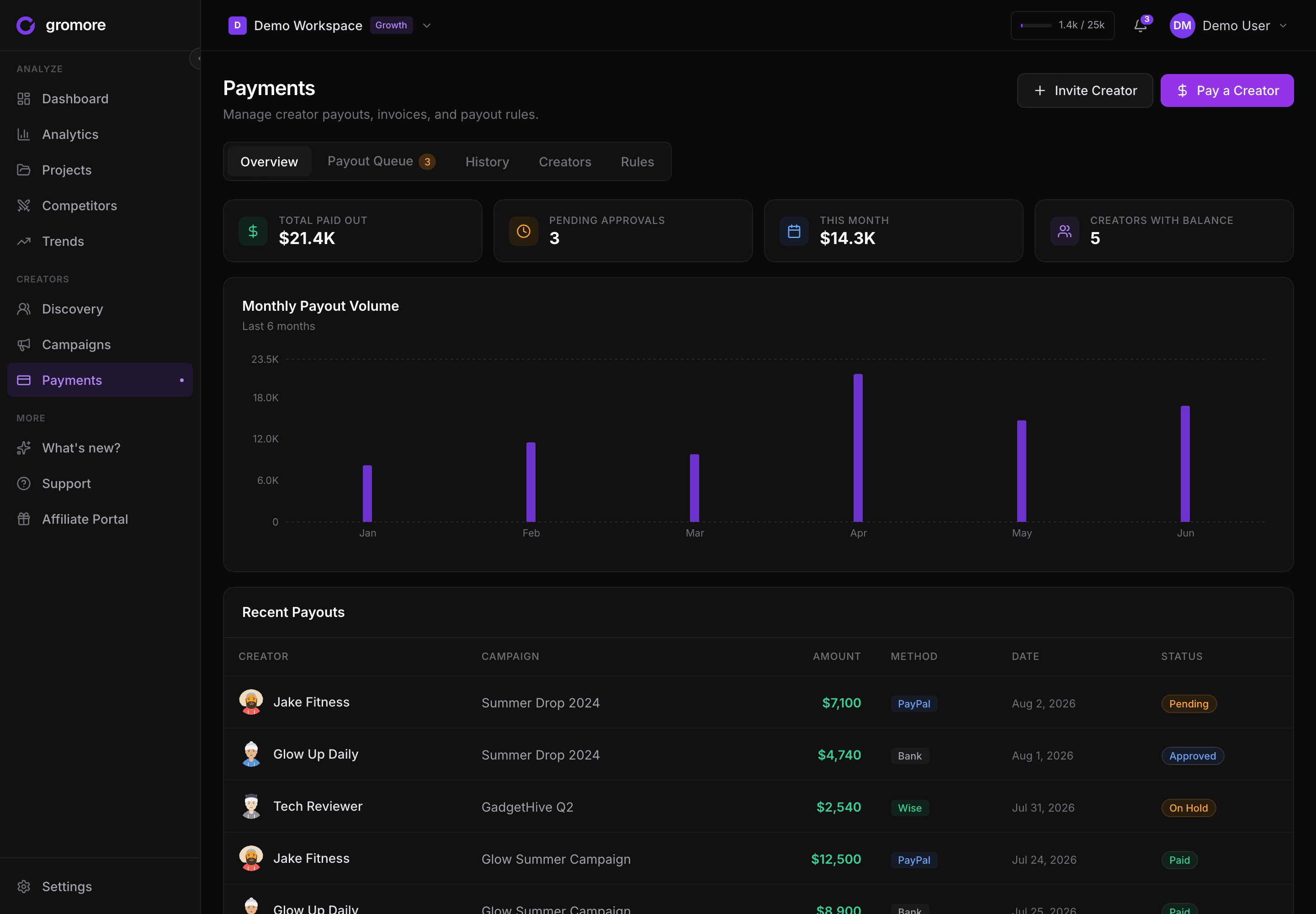
Gromore's payout rules engine turns any of these structures — per-video, retainer, or base + CPM + milestone — into rules it applies automatically to tracked performance (it calculates and records; you keep control of the actual transfer). See how to pay UGC creators for methods and influencer payment automation software for the tooling side.
Bottom line
Most UGC lands $50–$500/video by tier — and how you structure pay (per-video, retainer, or a base-plus-performance hybrid) matters as much as the number. Budget from content volume, weight spend toward proven creators, keep platform payouts mentally separate from your rates, and graduate to a hybrid model as you scale. For the full picture of measuring and running all of this, start with the guide to UGC analytics.
Want payouts calculated automatically from real performance instead of a spreadsheet? Start a free 7-day Gromore trial — no card required.