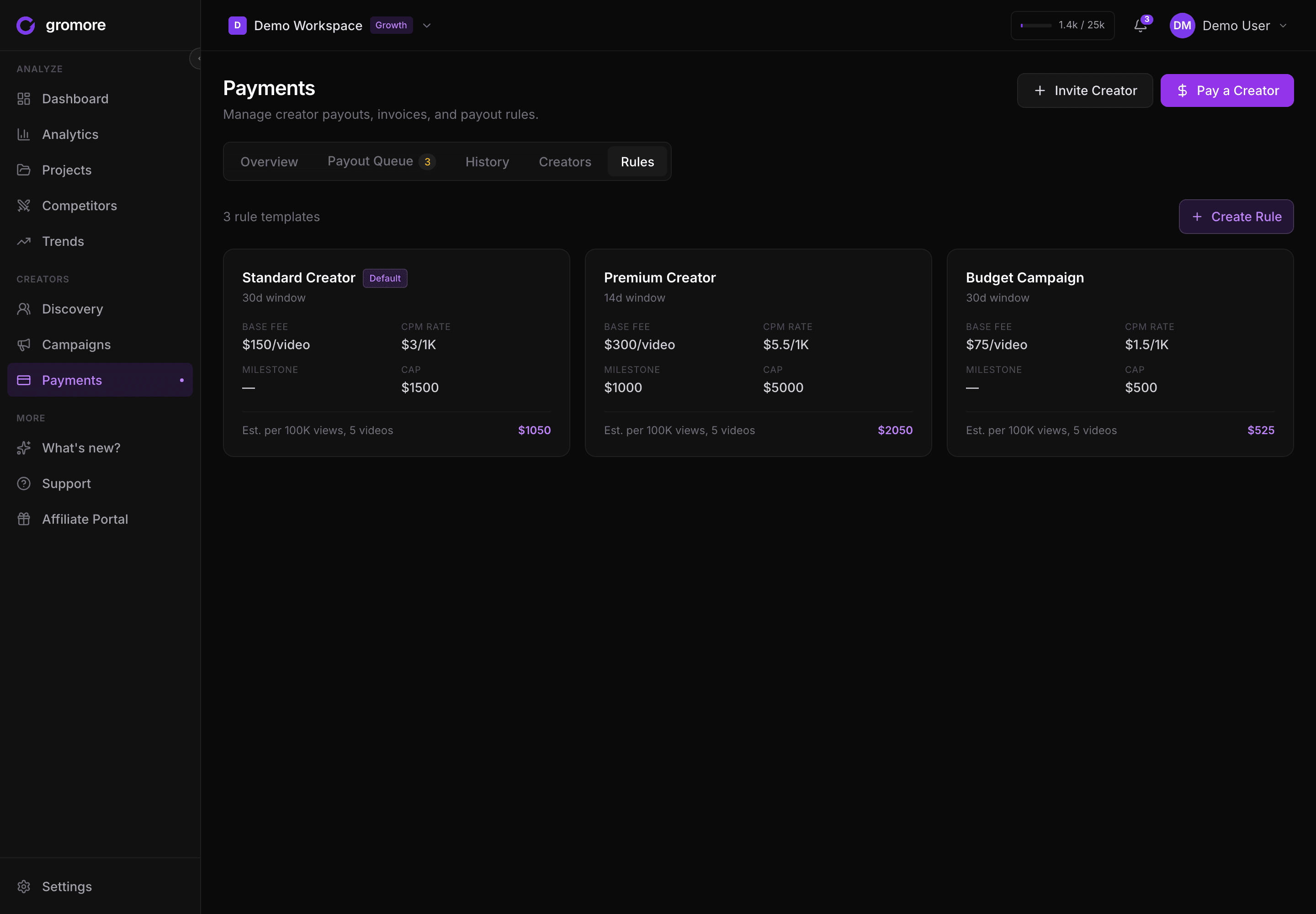
Short answer: Influencer payment automation software splits into two layers: tools that move the money (Tipalti, Lumanu, PayPal, Wise) and tools that decide and record what each creator is owed from performance, then route it for approval. Most brands need both — a calculation-and-approval layer like Gromore that turns base + CPM + milestone rules into an approved, audited payout, feeding a payment rail you pick. Gromore records and routes payouts; it doesn't send the funds.
Paying creators sounds simple until you're doing it for the fortieth time this month. Someone approves a batch of deliverables in one tool. Someone else opens a spreadsheet, looks up each creator's rate, adds the CPM bonus for the video that overperformed, checks whether a sales milestone was actually hit, converts a couple of payouts into euros, and finally logs into a payment portal to send it all. Then a creator emails asking where their money is, and the whole thing gets re-checked by hand.
The expensive part of creator payments was never the transfer itself — it's everything around it: calculating what each creator earned from performance, checking it, getting it approved, and reconciling the whole thing at month-end. For a brand at any real scale, that manual overhead is where the hours and the payment errors pile up — and it's exactly the part automation should remove.
That's the work payment automation is supposed to remove. But when you set out to automate creator payments, "automation" means two very different things depending on which tool you're looking at — and buying the wrong layer is how brands end up with a fast way to send money they're still calculating by hand.
What payment automation software should actually do
There are two separate jobs hiding inside "pay my creators," and almost every tool is built around one of them. Knowing which one you're buying is the whole game.
Layer 1 — decide and record what each creator is owed. This is the calculation, approval, and audit layer. Good software here:
- Turns performance into a number automatically — a base fee, plus CPM on views, plus milestone bonuses — using rules you set once, instead of someone re-typing amounts per creator.
- Routes each payout for approval before it's committed, so nothing is owed until a human signs off.
- Keeps an audit trail: who approved what, when, against which deliverable and which campaign.
- Rolls spend up per campaign, so you see cost-per-result — not just a bank total.
Layer 2 — actually move the money. This is the payment rail. Good software here:
- Supports multiple currencies and methods (ACH, PayPal, Wise, local bank rails).
- Handles tax compliance — collecting W-9/W-8 forms, prepping 1099/1042 filings.
- Consolidates everything into one invoice your finance team can reconcile.
- Settles in a predictable window, so creators aren't chasing you.
Here's the catch: most creator payout software is Layer 2 software. These tools are very good at sending money and handling tax forms — and they assume you already know the amount. But for performance-based UGC, the amount is the hard part. If a creator earns a base fee plus a few cents per thousand views plus a bonus for clearing a sales target, someone has to compute that, and Layer 2 tools generally don't. The best setup pairs the two: a calculation-and-approval layer that decides and records, feeding a rail that settles.
The tools, honestly compared
Here's a quick map of where the popular options sit. Treat any specific numbers below as commonly-reported claims to confirm for yourself — vendor capabilities and pricing change often.
| Tool | Layer | Best for | Honest watch-out |
|---|---|---|---|
| Tipalti | Money movement (AP automation) | Large, global programs with finance-led compliance | Enterprise pricing and setup; assumes the amount was decided elsewhere |
| CreatorIQ Pay | Platform + money movement | Enterprises already standardized on CreatorIQ | Enterprise commitment; bundled cost |
| Lumanu | Money movement (master vendor) | Offloading creator payment and tax admin | Sits outside where you track campaign performance |
| Modash | Discovery + money movement | Sourcing and paying from one discovery tool | Payments are secondary to its database core |
| PayPal / Wise | Money movement (raw rail) | Cheapest DIY payouts at any size | No calculation, approval, or tracking — spreadsheet-driven |
| Gromore | Calculation + approval + record | Performance-based UGC payouts that feed a rail you choose | Records and routes; does not send the funds |
Tipalti is genuinely strong, and for large, global programs it's hard to beat. It's an accounts-payable automation platform — reportedly spanning 200+ countries with deep tax and compliance handling — so if you're paying hundreds of creators across borders and your finance team needs airtight 1099/1042 workflows, this is the serious end of the market. What it isn't is a creator-campaign tool: it moves money and manages compliance, but it assumes the amount and the approval already happened somewhere else.
CreatorIQ Pay bundles payments into CreatorIQ's broader enterprise creator-marketing platform. If you're already a CreatorIQ customer, having payments in the same suite is convenient and keeps data in one place. It's an enterprise commitment, though — priced and scoped for large brands, not a lean D2C team.
Lumanu is built around a "master vendor" model: it pays your creators on your behalf and consolidates everything into a single invoice, which offloads a lot of tax and payment admin. Reports put its processed volume in the billions. That's a real strength if your main pain is the mechanics of paying — but it lives outside the place you actually track campaign performance.
Modash is primarily a creator-discovery database that has added payment features — commonly described as automatic monthly payouts with short bank settlement windows. Useful if you want sourcing and paying in one tool, but payments are secondary to its core.
PayPal and Wise are the honest default a lot of brands actually use: cheap, near-universal money-movement rails. They send funds and nothing more — no performance calculation, no approval routing, no campaign tracking. That work stays in your spreadsheet.
Gromore sits deliberately in Layer 1. It's the calculation, approval, and record layer — not a payment processor, and it doesn't move money. You define payout rules once (base + CPM + milestone), and as campaigns run it computes what each creator has earned, routes it through an approval workflow, and keeps an auditable record tied to the actual deliverable and its performance. When a payout is approved, you send the money through whatever rail you already use. In short, Gromore automates the deciding-and-recording half and hands a clean, approved number to the paying half.
Built-in vs. bolt-on: why campaign-native payouts matter
The reason the two layers matter so much in practice is reconciliation. When your payment tool is separate from where you approve creator work, every payout gets keyed twice: once when you approve the deliverable, again when you set up the payment. Between those two steps a lot goes wrong — the wrong rate, a missed CPM bonus, a milestone that was hit but not counted, a creator paid for a video that later got pulled.
A campaign-native payout collapses that. In Gromore, the same place you track a creator's views and approve their content is where the payout is calculated and recorded — so approve → record is one motion, computed against the exact performance numbers the platform already holds. There's no re-typing an amount into a second system, and no spreadsheet sitting between "approved" and "paid" quietly drifting out of sync.
To be clear about the boundary: Gromore still doesn't send the transfer. What it removes is the calculation-and-reconciliation step in the middle — the part that eats the hours. You get an approved, audited amount per creator, then push the money through your chosen rail. Bolt-on tools make the transfer fast; built-in calculation makes the number right. Pairing a solid creator content approval workflow with rules-based payout math is what actually shrinks the monthly admin.
Which setup fits your creator network size
Up to ~10 creators. Don't overbuy. A raw rail like PayPal or Wise, plus a lightweight way to calculate and record what you owe, is plenty. This is where Gromore's Starter tier fits — it computes and tracks payouts right alongside your UGC analytics, and you pay out manually. Enterprise AP platforms are overkill at this size.
Around 100 creators. This is where manual reconciliation quietly becomes a part-time job, and where the calculation layer earns its keep. You want performance-based payout rules and approval routing so the numbers are right and someone signs off before money moves — then feed the approved amounts to a rail. If your bigger headache is the payment mechanics and tax admin themselves, a master-vendor option like Lumanu can absorb that side while you run the campaign side elsewhere. If the headache is getting the amounts right and recorded, that's Gromore's lane. (Our guides to how much to pay UGC creators and creator payout structures cover the rules themselves.)
1,000+ creators, or global. Now enterprise money-movement earns its cost. Tipalti or CreatorIQ Pay handle the tax, compliance, and settlement scale that would break a spreadsheet — pair one with a calculation-and-approval layer so finance isn't hand-computing performance bonuses for a thousand people. Agencies running many client rosters at once have an extra wrinkle: this all has to stay separated per client. Gromore's Agency plan gives each client its own workspace (up to 10 workspaces, 20 seats), so calculation, approval, and records stay clean across brands — see multi-brand agency creator management for that setup. For the actual sending, how to pay UGC creators walks through the rail options.
Bottom line
"Influencer payment automation software" is really two markets wearing one label. The money-movement layer — Tipalti, Lumanu, PayPal, Wise — sends funds and handles tax; it's mature, and for global scale it's essential. The calculation-and-approval layer decides what each creator is actually owed from performance and keeps the record straight — and that's the half that eats your hours when it's done by hand.
Gromore is built for that second half. It turns base + CPM + milestone rules into an approved, audited payout tied to real campaign performance, then hands a clean number to whatever rail you pay through. It records and routes; it doesn't move the money — you keep control of the transfer. For a mid-market D2C brand or a UGC agency, automating the deciding-and-recording half is usually the bigger time win, because the sending was never the slow part.
Want to calculate, approve, and record creator payouts in the same place you track their performance? Start a free 7-day Gromore trial — no card required.